How Long Does Knee Replacement Surgery Take? The Complete Timeline

An operation is taking place in an operating room with surgeons working on a person's knee.
The question "how long does knee replacement surgery take?" has a short answer and a useful answer. The short answer is 60 to 90 minutes in the operating theatre. The useful answer covers everything from the day before admission to the day you return to normal life — because what patients really want to know when they ask this question is: how long will all of this take? How long before I am walking properly? How long before I can drive? How long before I can travel to my son's wedding in another city?
This guide answers the useful version, broken into specific phases, with India-specific additions that standard surgical timelines never include.
Pre-Admission: The Day Before Surgery
At KDSG Superspeciality Hospital in Greater Noida, patients having planned total knee replacement are typically admitted the evening before surgery or early morning of the surgery day.
What happens on admission:
- Blood tests confirming haemoglobin, clotting factors, blood sugar, kidney function
- Anaesthesia assessment — the anaesthesiologist reviews your medical history, medications, and decides the anaesthetic plan (almost always spinal anaesthesia for knee replacement)
- Pre-operative marking of the operated leg
- Fasting instructions: nothing to eat from midnight, clear fluids (water, diluted juice) usually allowed until 2 hours before surgery
- Starting blood sugar monitoring for diabetic patients
- Blood-thinning stockings fitted if not already worn
Time required: 2 to 4 hours for all pre-operative preparation on admission day.
Surgery Day: Hour by Hour
Arrival at the Operating Theatre Area (1 to 2 hours before surgery)
You are transferred from the ward to the pre-operative area outside the OT. An IV cannula is placed in the arm. Pre-operative antibiotics are given through the drip — this critical infection prevention step happens before skin incision.
The anaesthetic team places you in a sitting or side-lying position for the spinal injection. A fine needle is inserted between the vertebrae in the lower back. Within 3 to 5 minutes, complete numbness develops from the waist downward. Sedation is added — most patients are drowsy and comfortable but not fully unconscious. You feel nothing from the waist down for the duration of the surgery.
In the Operating Theatre: 60 to 90 Minutes
For a straightforward total knee replacement by Dr. Ankur Singh, the operative time is typically 60 to 90 minutes. Bilateral (both knees at once) surgery takes 90 to 150 minutes.
What is happening inside those 90 minutes
Positioning and preparation (10 minutes): The leg is positioned, cleaned with antiseptic, and draped with sterile sheets. A tourniquet is placed on the thigh to reduce bleeding. The OT team is the surgeon, an assistant, the anaesthesiologist, a scrub nurse, and a circulating nurse.
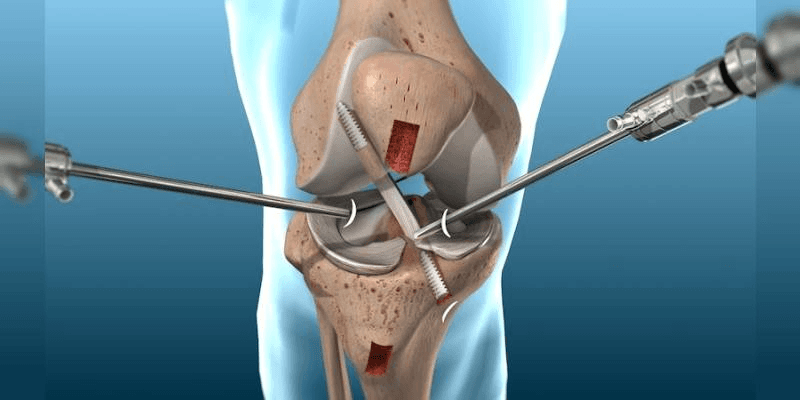
Approach (10 minutes): An 8 to 12 cm incision is made over the front of the knee. The kneecap is gently displaced to one side to expose the joint.
Bone preparation (20 to 30 minutes): Using precision cutting guides (or real-time robotic guidance in a robotic procedure), the arthritic surfaces of the femur and tibia are removed in carefully planned cuts. The bone surfaces are prepared to receive the implant components.
Trial fitting and alignment check (10 minutes): Trial implants are placed and the knee is moved through its range of motion. Alignment, stability, and gap balance are checked. Adjustments are made before any permanent fixation.
Final implant placement (10 to 15 minutes): The final metal and plastic components are fixed — typically cemented into the bone. The knee is again moved to confirm function.
Closure (15 minutes): The wound is closed in layers. A drain may be placed to remove post-operative blood collection. Dressing applied.
Recovery Room: 1 to 2 Hours
You are transferred to the recovery room where nursing staff monitor pulse, blood pressure, temperature, oxygen, and pain levels as the spinal anaesthetic begins to wear off. Pain medication through the drip is given as needed.
The spinal anaesthesia wears off over 2 to 4 hours — you will begin feeling the leg again, starting with pins and needles. Pain management is given before it wears off completely.
Once observations are stable, you are transferred to the orthopaedic ward.
Hospital Stay: 3 to 5 Days
The typical hospital stay after total knee replacement at KDSG Hospital is 3 to 5 days. Discharge happens when:
- Pain is controlled with oral medication
- You can walk with a walking frame safely
- You can manage 4 to 5 steps with supervision
- The wound is clean and dry
- Blood tests are satisfactory
- Blood-thinning medication has been initiated
Day 1 (Day after surgery): Physiotherapist visit to begin ankle pumps, quad exercises, and assisted standing. First walking attempt — short distance with frame.
Day 2: Longer walking sessions. Stairs practice under supervision. Wound dressing check.
Day 3 to 5: Progressive walking. Discharge planning — ensuring the home is ready (commode riser, cleared paths, someone present at home), medication dispensed, follow-up appointment booked.
Home Recovery: The First 6 Weeks
This is the phase that determines how well the knee ultimately functions. The timeline below is typical — individual variation exists.
| Milestone | Typical Timeframe |
|---|---|
| Walking with frame | Day 1 after surgery |
| Hospital discharge | Day 3 to 5 |
| Walking without limping (with frame) | Weeks 1 to 2 |
| Transition to single crutch or stick | Weeks 3 to 5 |
| Walking without any aid | Weeks 4 to 6 |
| Driving a car (right knee) | Weeks 6 to 8 |
| Return to desk job | Weeks 6 to 8 |
| Climbing stairs normally | Weeks 4 to 8 |
| Stationary cycling | Week 3 to 4 |
| Swimming | Month 2 (wound must be healed) |
India-Specific Timeline Questions
These are the questions Indian patients actually ask that Western surgical timelines never address:
When can I use a squat toilet?
Indian squat toilets are not safe for the first 3 months after total knee replacement. A raised commode seat or standalone commode chair is required before returning from hospital. After 3 to 4 months, with Dr. Ankur Singh's specific clearance, modified Indian toilet use may be attempted — with grab support.
When can I ride a scooter?
A scooter (automatic transmission) requires stable knee function and rapid response capability. Most patients can ride a scooter by 3 to 4 months. A manual gearbox motorcycle — which requires clutch operation and precise footpeg control — is appropriate from 4 to 5 months. Delhi-NCR road conditions require completely recovered function before resuming two-wheeler riding.
When can I sit cross-legged on the floor?
Modified cross-legged sitting (with a firm cushion raising the hips) may be possible from 4 to 6 months for patients with good flexion recovery. Full deep padmasana (lotus) is not recommended after total knee replacement. Partial knee (UKR) replacement typically allows better deep flexion and may permit cross-legged sitting earlier.
When can I attend a family function with floor seating?
By months 3 to 4 most patients can attend functions with chair seating arranged in advance. Floor-level seating at family functions — including weddings and religious ceremonies — typically requires months 4 to 6 and specific clearance.
When can I travel by train or plane?
Short journeys (2 to 3 hours) by car or train: from weeks 6 to 8 with frequent movement breaks during the journey. Air travel: from weeks 8 to 12 for domestic flights. Long-haul international travel: from months 3 to 4.
The Full Recovery Timeline: 6 Months
| Timepoint | What Most Patients Experience |
|---|---|
| 6 weeks | Walking with stick. Driving. Back at desk work. |
| 3 months | Walking without aids. Light daily activities normal. |
| 4 months | Climbing stairs confidently. Most household tasks. |
| 6 months | Full recovery for most patients. Normal daily life. |
Complete recovery — where the knee stops being something you think about during daily activity — typically happens between 3 and 6 months. Some patients report the knee continuing to improve for up to 12 months as the muscles rebuild and the nervous system adapts to the new joint mechanics.
Frequently Asked Questions
Does the surgery take longer for older patients?
Operative time is determined primarily by the complexity of the anatomy and deformity, not by age. An 80-year-old with straightforward arthritis may have a faster operative time than a 55-year-old with severe varus deformity. Age affects anaesthesia and recovery complexity, not the surgical duration itself.
Does robotic knee replacement take longer?
Robotic-assisted surgery adds pre-operative planning time (CT scan, digital planning session) and a brief intraoperative registration step — overall, it adds approximately 10 to 20 minutes to the operative time compared to conventional surgery. The benefit in alignment accuracy is considered well worth this additional time.
How long does bilateral (both knees together) surgery take?
Simultaneous bilateral knee replacement takes 90 to 150 minutes for both knees — not twice the time, because preparation and closure are shared. Hospital stay is typically 5 to 7 days for bilateral cases.
How do I book a consultation for knee replacement in Noida?
Call the number listed on this website. Consultations at Renew Orthopedic Clinic, Sector 47 Noida. Surgery at KDSG Superspeciality Hospital, Greater Noida.
Dr. Ankur Singh | Best Knee Replacement Surgeon in Noida | Knee Replacement Surgery Timeline | KDSG Superspeciality Hospital Greater Noida | Renew Orthopedic Clinic Sector 47 Noida
Medical Disclaimer
The information provided on this website is for educational purposes only and should not be considered as medical advice. Please consult Dr. Ankur Singh or a qualified healthcare professional for personalized medical guidance.
Share this blog:
 Copy
Copy




-compressed.jpg)
