Is Knee Replacement Surgery Safe? The Honest, Evidence-Based Answer

Doctor examining the leg of a senior woman during a consultation for potential knee replacement surgery.
This is one of the most commonly asked questions before knee replacement — and one of the questions that deserves a properly specific answer rather than a reassuring wave of the hand.
Knee replacement is very safe. It is also major surgery. Both of these things are simultaneously true, and understanding both clearly is what allows patients to make informed decisions and approach their procedure with appropriate — rather than excessive — concern.
The short answer: total knee replacement performed by an experienced surgeon in a well-equipped facility has complication rates that are low and declining, success rates that are among the highest in medicine, and a safety profile that compares favourably to many procedures most patients consider routine.
The complete answer requires knowing what the specific risks are, what their actual incidence is, how they are prevented and managed, and what specific factors make any individual patient higher or lower risk.
What "Safe" Actually Means in Surgery
In medicine, no procedure is without risk. "Safe" does not mean risk-free — it means that the carefully measured probability of complications is low enough, and the benefit of the procedure is significant enough, that for appropriately selected patients, the balance clearly favours having the surgery.
For severe knee arthritis that has failed conservative management, knee replacement consistently delivers that balance: dramatic, lasting improvement in quality of life, with low rates of serious complications.
The Specific Risks: Actual Incidence Data
1. Deep Vein Thrombosis (DVT) — Blood Clot in the Leg
The risk: After any lower limb surgery, the combination of reduced activity and surgical trauma to blood vessels creates conditions where a clot can form in the deep leg veins.
The incidence: Without preventive measures, DVT occurs in up to 50 percent of patients after knee replacement. With modern prevention protocols (blood thinning medication for 2 to 4 weeks, compression stockings, walking from Day 1, hydration), clinically significant DVT occurs in less than 1 to 2 percent of patients.
How it is prevented at KDSG: Blood-thinning tablets from Day 1 post-surgery, compression stockings during the hospital stay, mobilisation beginning Day 1, and adequate fluid intake. Patients are taught to recognise the symptoms of DVT (calf pain, warmth, swelling) before discharge.
Pulmonary embolism (PE): A DVT clot that travels to the lungs is the most feared DVT complication. With modern prevention, PE occurs in less than 0.2 to 0.5 percent of patients.
2. Surgical Site Infection
The risk: Bacteria can contaminate the wound or joint either during or after surgery, causing infection around the new implant.
The incidence: Superficial wound infection (skin level only) occurs in 1 to 3 percent. Deep periprosthetic joint infection (PJI — infection around the implant) occurs in 0.5 to 2 percent. PJI is the most serious knee replacement complication because it may require further surgery.
How it is reduced at KDSG: Pre-operative antibiotics administered before skin incision, a laminar flow (filtered, sterile air) operating theatre, meticulous sterile technique, post-operative wound monitoring, and patient education about wound care at home. Patients are specifically advised to report any spreading redness, discharge, or fever within 6 weeks of surgery.
Long-term infection risk: Even years after knee replacement, bacteraemia from dental procedures, urinary tract infections, or skin infections can seed the implant through the bloodstream. Patients with knee replacements are advised to take preventive antibiotics before major dental procedures.
3. Nerve and Blood Vessel Injury
The incidence: Clinically significant nerve injury occurs in less than 0.3 to 0.5 percent of knee replacements. Injury to major blood vessels around the knee is even rarer at less than 0.1 percent.
Why it occurs: The major neurovascular structures around the knee (common peroneal nerve, popliteal vessels) are in proximity to the surgical field. Experienced surgeons know their anatomy precisely — experience directly reduces this risk.
4. Implant Problems
Stiffness (arthrofibrosis): Excessive scar tissue can restrict range of motion after surgery. Occurs in 1 to 5 percent of patients. Prevented by early physiotherapy; treated with manipulation under anaesthesia if detected early.
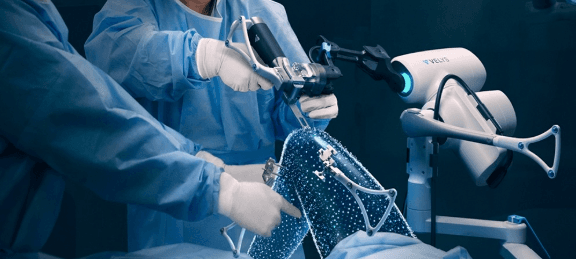
Implant loosening: The long-term risk of the implant gradually losing its fixation to bone (aseptic loosening). Occurs in 5 to 10 percent of patients at 15 to 20 years. Robotic surgery's accuracy advantage — ensuring optimal mechanical alignment — reduces the uneven loading that accelerates loosening.
Instability: The knee feeling unstable or giving way. Occurs in 1 to 3 percent. Related to soft tissue balancing during surgery — another area where surgical experience directly matters.
5. Anaesthesia Risks
Modern anaesthesia for knee replacement in India is very safe. Spinal anaesthesia — the standard technique for knee replacement — avoids the risks of general anaesthesia (respiratory complications, nausea) and provides excellent post-operative pain control. The anaesthetic team at KDSG is experienced with medically complex patients including those with controlled diabetes and hypertension.
What Makes Any Individual Patient Higher or Lower Risk
The population-level statistics above are averages. Individual risk varies
Higher risk factors:
- Diabetes mellitus: doubles wound infection risk. Well-controlled diabetes (HbA1c below 8%) substantially reduces this
- Obesity (BMI above 35): increases wound healing problems, DVT risk, and long-term implant loading
- Smoking: impairs wound healing and increases infection risk. Stopping 4 to 6 weeks before surgery reduces risk measurably
- Prior knee surgery: especially prior infection or complex reconstruction
- Immunosuppressive medication (steroids, rheumatoid medications): increases infection risk, managed with pre-operative protocol adjustments
Lower risk factors:
- Younger, physically fit patients
- Well-controlled medical conditions
- Non-smoker, healthy BMI
- High-volume experienced surgeon
- Modern surgical facility with appropriate equipment
The pre-operative assessment with Dr. Ankur Singh at Renew Orthopedic Clinic, Sector 47 Noida, specifically addresses individual risk factors and discusses how each is managed.
How Safety Has Improved Over Time in India
Indian outcomes for knee replacement have improved substantially over the past 15 years:
- Adoption of fast-track recovery protocols (walking within 24 hours) has dramatically reduced DVT rates
- Modern blood-thinning agents have replaced older, more complex anticoagulation
- Spinal anaesthesia with nerve blocks has reduced respiratory complications
- Computer navigation and robotic guidance have reduced implant malpositioning
- Improved wound care protocols have reduced infection rates
The combination of these advances means that a knee replacement at a quality centre in Greater Noida in 2026 is significantly safer than the same procedure performed 15 years ago, even as the same procedure is now being offered to older and medically more complex patients.
Weighing Risk Against Benefit: The Correct Framework
The safety question must ultimately be answered in context: what is the risk of having the surgery, compared to the risk of not having it?
The risk of the surgery: Well-defined, low, and further reducible by patient optimisation.
The risk of not having it: Continuing severe arthritis produces its own consequences — increasing immobility, muscle wasting, cardiovascular deconditioning from reduced activity, psychological impact of chronic pain, fall risk from compromised gait, progressive joint deformity that makes eventual surgery more complex.
For patients in whom the indication for surgery is correct — severe arthritis that has genuinely failed conservative management — the benefit-risk balance is not ambiguous. This is why knee replacement consistently ranks among the highest patient-satisfaction procedures in medicine: the baseline before surgery is genuinely terrible, and the outcome is genuinely good.
Frequently Asked Questions
Is knee replacement safe for patients over 75?
Age alone is not a contraindication to knee replacement. The relevant factors are medical fitness (cardiac, respiratory, renal function), functional status, and the patient's goals. Elderly patients with significant frailty require more careful assessment, and the timing of surgery should account for the higher nutritional and physiotherapy demands of recovery.
Is it safe if I have diabetes?
Yes, with appropriate management. Diabetes increases infection and wound healing risk — but these risks are substantially reduced by pre-operative optimisation (HbA1c below 8%), careful blood glucose monitoring during and after surgery, and meticulous wound care. Many thousands of diabetic Indians undergo successful knee replacement annually.
Is robotic knee replacement safer than conventional?
Robotic surgery primarily improves accuracy rather than reducing immediate complication risk. The safety profile of the surgery itself (DVT, infection, nerve injury risk) is similar for robotic and conventional. The safety advantage of robotic guidance is long-term: better alignment produces lower revision rates at 15 to 20 years.
How do I book a consultation to discuss my specific risk profile?
Call the number listed on this website. Consultations at Renew Orthopedic Clinic, Sector 47 Noida. Surgery at KDSG Superspeciality Hospital, Greater Noida.
Dr. Ankur Singh | Best Knee Replacement Surgeon in Noida | Knee Replacement Safety India | KDSG Superspeciality Hospital Greater Noida | Renew Orthopedic Clinic Sector 47 Noida
Medical Disclaimer
The information provided on this website is for educational purposes only and should not be considered as medical advice. Please consult Dr. Ankur Singh or a qualified healthcare professional for personalized medical guidance.
Share this blog:
 Copy
Copy


/doctor-hospital-room-with-knee-injury-compressed.jpg)

