Knee Arthroscopy Recovery: How Fast Can You Really Get Back to Normal?

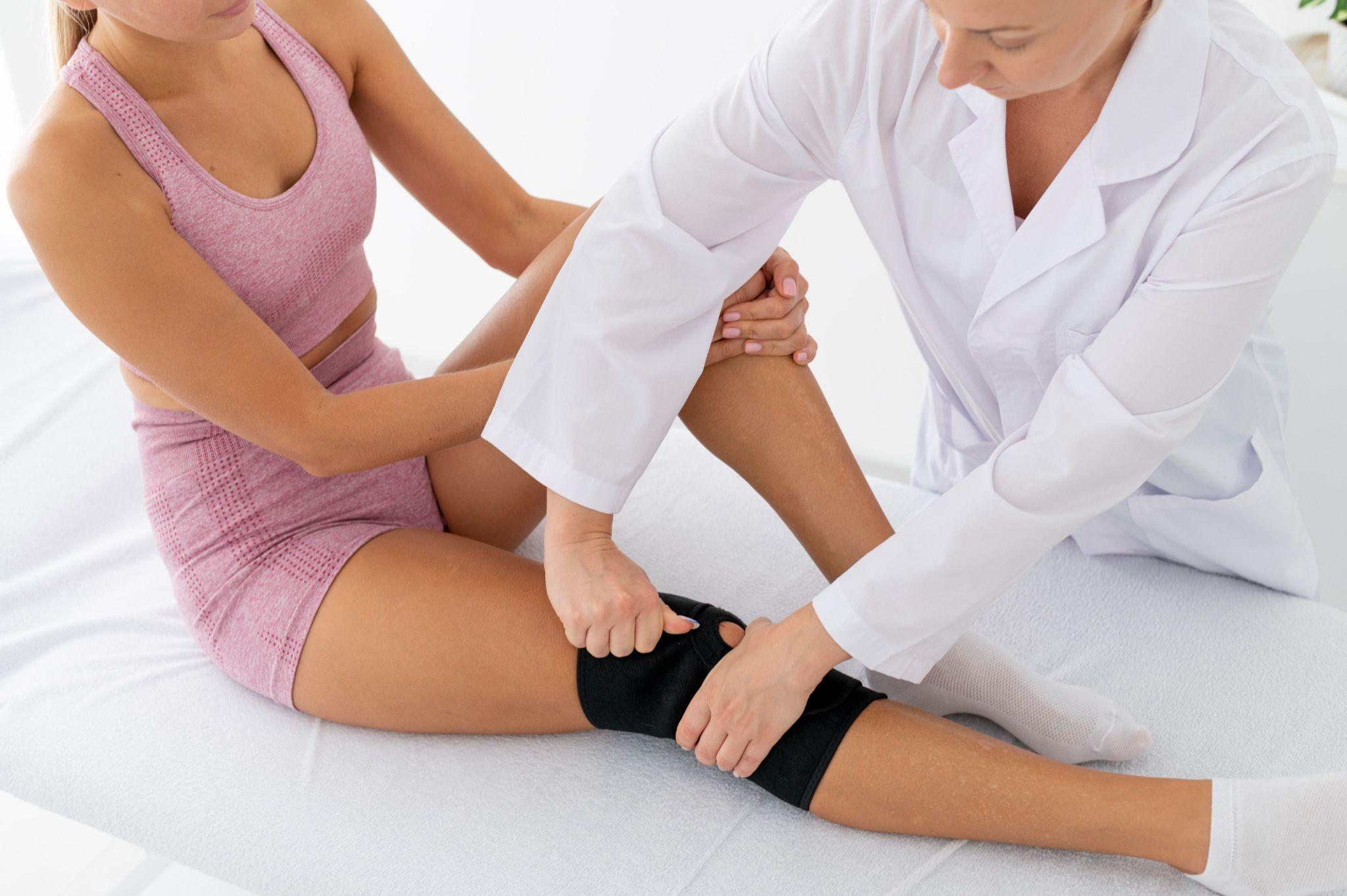
Physiotherapist applying knee support bandage as part of post-injury rehabilitation. Physiotherapy helps improve strength, mobility, and recovery after knee fractures or surgery.
Knee arthroscopy is one of the most performed surgical procedures in orthopedics — and one of the most misunderstood in terms of recovery. Patients arrive expecting to be walking normally within a week. Others are told by well-meaning relatives that they will need months off work. Neither is reliably accurate.
The truth is: recovery after knee arthroscopy depends almost entirely on what was done inside the knee — and the variation is significant. A diagnostic arthroscopy and washout has a dramatically different recovery from an ACL reconstruction performed through the same small incisions.
Dr. Ankur Singh performs a high volume of knee arthroscopic procedures at KDSG Superspeciality Hospital in Greater Noida — diagnostic arthroscopy, meniscal repair and partial meniscectomy, ACL and PCL reconstruction, cartilage treatment, and loose body removal. Each procedure has a different recovery timeline, different physiotherapy requirements, and different answers to the questions Indian patients most frequently ask: when can I go back to the office, ride a two-wheeler, resume cricket, manage the metro commute?
This guide answers all of those questions, procedure by procedure.
What Happens During Knee Arthroscopy
All knee arthroscopic procedures are performed through 2 to 3 small incisions (each less than 1 cm) around the knee. A camera (arthroscope) is inserted through one incision; surgical instruments through the others. The inside of the knee is filled with saline fluid to create a clear working space.
Most knee arthroscopy is performed as day-care surgery at KDSG Hospital, Greater Noida — the patient arrives in the morning and returns home in the evening. Anaesthesia is typically spinal (numb from the waist down) with sedation, so the patient is relaxed and unaware of the procedure. In some cases — particularly for ACL reconstruction — a nerve block is added specifically for post-operative pain control.
After the procedure, the small incisions are closed with a suture or adhesive strip and covered with a dressing. The knee is usually wrapped in a compression bandage.
The First 48 Hours After Knee Arthroscopy (All Procedures)
Regardless of what was done inside the knee, the first 48 hours look broadly similar:
At home on the day of surgery: Rest with the leg elevated — heel on a firm pillow, knee slightly elevated above hip level. Ice wrapped in a cloth applied for 20 minutes every 2 hours. This is the most important window for controlling the initial swelling and pain.
Pain: Most patients are pleasantly surprised by how manageable the pain is compared to what they imagined. The nerve block from the spinal anaesthetic takes several hours to fully wear off. As it does, take the prescribed pain medication before the pain becomes severe — it is easier to control pain that is beginning than pain that is established.
Swelling: The knee will be swollen for several weeks after any arthroscopic procedure. Some of this is from the saline fluid used to distend the knee during surgery (which the body absorbs over 24-48 hours). The rest is the body's natural inflammatory response to the procedure. Swelling does not mean something is wrong.
Weight-bearing: Most arthroscopic procedures allow immediate weight-bearing as comfortable. The exception is meniscal repair, where weight-bearing may be restricted for 2 to 4 weeks depending on the repair type and location.
First wound check: The dressing stays on for 48 to 72 hours. After that, the wound can be inspected. A small amount of dried blood or serous fluid on the original dressing is normal. Fresh blood or wetness at 72 hours — call the clinic.
Procedure-by-Procedure Recovery Guide
1. Diagnostic Arthroscopy and Joint Washout
What this involves: Camera only (or camera plus thorough lavage of the joint) to assess the internal structures and remove debris and inflammatory material.
Recovery timeline:
- Walking: Same day to next day, normal walking without a limp within 1 to 2 weeks
- Return to desk work: 3 to 7 days
- Return to driving: 1 to 2 weeks
- Return to light sport: 3 to 4 weeks
- Return to full sport: 4 to 6 weeks
What to expect: This is the fastest recovery of any arthroscopic procedure. The structures inside the knee have been assessed but not significantly altered. The main limiting factor is swelling and minor wound discomfort.
2. Partial Meniscectomy (Trimming of Torn Meniscus)
What this involves: The torn or damaged portion of the meniscus is trimmed away, leaving the healthy meniscal tissue intact. No suturing is required.
Recovery timeline:
- Walking without limp: 1 to 3 weeks
- Return to desk work: 1 to 2 weeks
- Return to driving: 2 to 3 weeks
- Return to light activity (swimming, flat cycling): 3 to 4 weeks
- Return to sport: 4 to 8 weeks depending on sport demands
What to expect: One of the most common arthroscopic procedures in Dr. Ankur Singh's practice. Recovery is relatively fast because nothing has been repaired — tissue has been removed. The knee needs time to settle the initial inflammatory response, but the mechanical function is usually normal quite quickly.
3. Meniscal Repair (Suturing the Meniscus)
What this involves: The torn meniscus is reattached to its original position using sutures passed through the tissue and secured. This is the preferred approach when the tear is in a vascular area capable of healing — it preserves the meniscus rather than removing it, which is better for long-term joint health.
Recovery timeline — importantly slower than meniscectomy:
- Protected weight-bearing on crutches: 4 to 6 weeks (partial to non-weight bearing depending on the repair type)
- Return to desk work: 4 to 6 weeks (working from home earlier if possible)
- Return to driving: 6 to 8 weeks
- Return to swimming: 8 to 12 weeks
- Return to sport: 4 to 6 months
What to expect: The longer recovery reflects the biological reality of tissue healing. The repaired meniscus needs time to heal to the bone — healing that is disrupted by too-early loading. Patients who rush this recovery risk the sutures pulling through the tissue and the repair failing, requiring the meniscus to be trimmed rather than preserved.
Dr. Ankur Singh discusses the specific weight-bearing protocol for each meniscal repair individually, as it varies depending on the location and type of tear.
4. Loose Body Removal
What this involves: Loose fragments of cartilage or bone floating in the joint are identified and removed. Sometimes these are causing locking or catching of the knee; sometimes they are discovered incidentally.
Recovery timeline:
- Walking normally: 1 to 2 weeks
- Return to desk work: 1 to 2 weeks
- Return to full activity: 3 to 6 weeks
What to expect: Similar to diagnostic arthroscopy in terms of recovery pace. The most noticeable change is usually the immediate elimination of the locking or catching sensation that brought the patient to surgery.
5. Cartilage Treatment (Microfracture / Debridement)
What this involves: Damaged cartilage is either debrided (smoothed/trimmed) or treated with microfracture (small holes drilled in the exposed bone to stimulate fibrocartilage formation). The specific technique depends on the size and depth of the cartilage defect.
Recovery timeline:
- Protected weight-bearing: 4 to 8 weeks (for microfracture)
- Return to desk work: 4 to 6 weeks
- Return to swimming and cycling: 3 to 4 months
- Return to sport: 6 to 12 months
What to expect: Microfracture requires a prolonged non-weight bearing period to allow the fibrocartilage to form in the treated area without being compressed before it has matured. This is one of the longer arthroscopic recoveries. The physiotherapy programme is specific and essential.
The Indian-Specific Questions
When can I ride a two-wheeler?
This question is asked by almost every Indian arthroscopy patient, and it is a reasonable one — two-wheelers are the primary transport for a large proportion of Noida's working population.
For simple procedures (partial meniscectomy, loose body removal): scooter riding on flat, low-traffic surfaces may be possible at 4 to 6 weeks. Motorcycle riding (which requires more knee extension control for clutch and footpeg management) at 6 to 8 weeks.
For meniscal repair: no two-wheeler for 3 to 4 months minimum, as the dynamic loading of clutch and brake requires forces that stress the healing repair.
For ACL reconstruction: see the ACL recovery guide separately. No two-wheeler for 4 to 6 months.
When can I commute by metro or bus?
The metro commute in Noida — particularly during peak hours — involves prolonged standing, pushing, and sudden deceleration forces. For most simple arthroscopic procedures, metro commuting can begin at 3 to 4 weeks. For procedures requiring protected weight-bearing (meniscal repair), the busy metro is not appropriate until crutches are fully discontinued and the knee is fully weight-bearing.
When can I go back to cricket?
For partial meniscectomy: light fielding at 6 to 8 weeks, bowling and batting at 8 to 12 weeks. For meniscal repair: no cricket for 4 to 6 months. For ACL reconstruction: 9 to 12 months minimum. The twisting, cutting, and high-loading demands of cricket on the knee make this one of the later return-to-sport decisions.
Can I sit cross-legged after meniscal surgery?
Cross-legged sitting requires significant knee flexion (90+ degrees) and some rotation. For partial meniscectomy, cross-legged sitting is usually possible at 4 to 6 weeks as swelling settles. For meniscal repair, this position should be avoided for 3 to 4 months while the repair heals.
Signs That Recovery Is NOT Going Normally
Most arthroscopy recoveries are smooth. But these signs warrant calling the clinic:
- Fever above 38.5°C — possible early infection
- The knee becoming more swollen, not less, after day 5
- Wound discharge (yellow, green, or smelly)
- Severe pain that is worsening rather than improving after day 3
- Loss of sensation in the foot
And go to A&E immediately if: calf becomes painful, warm, and swollen (possible DVT), or breathlessness develops.
Frequently Asked Questions
Is knee arthroscopy a major surgery?
It is performed through small incisions and most patients go home the same day, but it is still a surgical procedure under anaesthesia that accesses the interior of a joint. It should be taken seriously in terms of wound care, medication, and gradual return to activity.
Do I need physiotherapy after knee arthroscopy?
Yes — for all but the simplest procedures. Physiotherapy restores the muscle strength around the knee and the movement patterns that protect the joint. For ACL reconstruction and meniscal repair in particular, physiotherapy is as important as the surgery itself.
How many arthroscopic procedures does Dr. Ankur Singh perform?
Dr. Ankur Singh performs a high volume of knee arthroscopic procedures annually at KDSG Superspeciality Hospital in Greater Noida. The full range of procedures — diagnostic, meniscal, ligament, cartilage, and shoulder arthroscopy — are within his regular practice.
Dr. Ankur Singh | Best Knee Arthroscopy Surgeon Noida | Meniscal Surgery Recovery | ACL Surgery Noida | KDSG Superspeciality Hospital Greater Noida | Renew Orthopedic Clinic Sector 47
Medical Disclaimer
The information provided on this website is for educational purposes only and should not be considered as medical advice. Please consult Dr. Ankur Singh or a qualified healthcare professional for personalized medical guidance.
Share this blog:
 Copy
Copy