Frozen Shoulder (Adhesive Capsulitis): The Complete Treatment Guide

Frozen shoulder passes through three stages, and each stage calls for a different treatment.
Frozen shoulder is one of the most reliably unpleasant orthopedic conditions an otherwise healthy person can develop. It begins with pain — typically in the front or outer part of the shoulder — that is disproportionately severe at night. Over weeks and months, the shoulder progressively stiffens. Then a third phase arrives where the stiffness slowly and incompletely resolves.
In many patients the whole process takes 18 months to 3 years. Most of the suffering within those years is unnecessary — because treatment actually works, when it is the right treatment for the right stage.
The frustrating reality is that most Indian patients with frozen shoulder receive generic physiotherapy at all stages of the condition. They are given shoulder exercises that are appropriate for impingement or rotator cuff disease, not for adhesive capsulitis. They continue to be in pain, continue to lose range of motion, and eventually either improve on a very prolonged timeline or develop permanent residual restriction.
This guide explains what frozen shoulder actually is, how to identify which stage you are in, and what the evidence says should be done at each stage.
What Frozen Shoulder Is — and What It Is Not
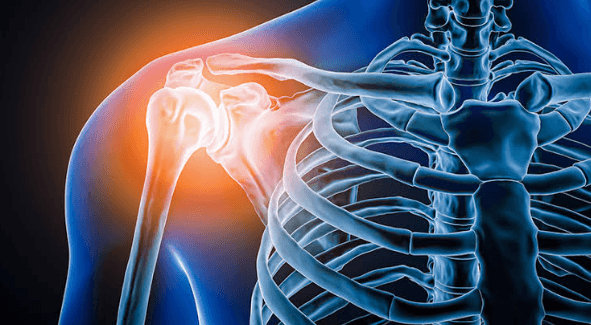
Adhesive capsulitis (frozen shoulder) is a condition in which the capsule — the connective tissue envelope surrounding the shoulder joint — becomes inflamed, thickened, contracted, and scarred. The joint capsule normally has sufficient slack and extensibility to allow the shoulder's enormous range of motion. In frozen shoulder, it contracts around the joint, physically restricting movement in all directions.
What makes it different from other causes of shoulder pain:
- Stiffness is global — movement is restricted in all planes (not just one direction as in rotator cuff disease or impingement)
- Passive movement (the doctor moving your arm, you not actively engaging muscles) is also restricted — this distinguishes it from pain-related guarding, where the patient restricts their own movement but passive movement is normal
- There is no specific injury that caused it in most cases
Who gets frozen shoulder: It most commonly affects adults between 40 and 60 years of age. Women are affected slightly more often than men. People with diabetes have three to five times the risk of frozen shoulder compared to non-diabetics — this is clinically significant in India where diabetes affects over 100 million adults. Thyroid disease, cardiac disease, and prolonged immobility (arm in sling) are also risk factors.
What causes it: Despite extensive research, the exact trigger for idiopathic (spontaneous) frozen shoulder is not known. The initial event appears to be inflammation in the rotator interval (a specific part of the shoulder capsule), followed by progressive fibrosis — the formation of dense fibrous scar tissue that contracts the capsule.
The Three Stages — and Why They Matter for Treatment
Frozen shoulder progresses through three distinct stages, each with different predominant features and different treatment implications. Most treatment failures in India occur because the same treatment is applied regardless of stage.
Stage 1: The Freezing Stage (Typically 2 to 9 Months)
What it feels like: Severe shoulder pain, disproportionately bad at night. The pain often wakes patients from sleep — reaching overhead, lying on the affected side, and any sudden movement of the arm provoke sharp pain. Range of motion begins to reduce but may still be fairly good relative to the intensity of the pain.
What is happening: Active inflammation in the shoulder capsule. The synovium (joint lining) is producing inflammatory cytokines. This is the phase where pain dominates and motion restriction is secondary.
What works at this stage: The priority is pain management. Aggressive physiotherapy with stretching and mobilisation during this phase risks exacerbating the inflammatory process — the capsule is already inflamed, and forced stretching stimulates more inflammation.
Corticosteroid injection into the glenohumeral joint (intra-articular steroid) is the most effective intervention for Stage 1. Research confirms that steroid injections in the early stages produce clinically significant pain reduction, allow more effective physiotherapy, and appear to reduce the overall duration of the condition. The 2025 published data from the Cureus journal confirms pain reduction exceeding the minimum clinically important difference in most patients who receive timely injection in Stage 1.
Gentle pendulum exercises (allowing the arm to swing with gravity, not actively raising it) maintain some movement without provoking the inflammation. Sleeping with a pillow under the arm (supporting the shoulder in a slightly forward position) significantly reduces the worst night pain for many patients.
Stage 2: The Frozen Stage (Typically 4 to 12 Months)
What it feels like: The severe night pain of Stage 1 has reduced — many patients feel they are "improving." But they are not — the inflammation is cooling but the stiffness is at its worst. The shoulder feels physically blocked. Reaching overhead, reaching behind the back, reaching across the body — all are significantly restricted. Pain is now most prominent at the end of the restricted range, not throughout movement.
What is happening: The inflammatory phase is resolving, but fibrous tissue has replaced the normal capsule. This fibrous tissue is what physically restricts movement. The joint volume is reduced — a normal shoulder joint holds about 30 ml of fluid; a frozen shoulder in Stage 2 holds 5 to 10 ml.
What works at this stage: Now physiotherapy becomes the priority — because the pain is more manageable and because the fibrous capsule needs progressive stretching to lengthen. Joint mobilisation by an experienced physiotherapist (Maitland mobilisation, Mulligan techniques) combined with sustained end-range stretching is most effective.
Hydrodilatation — distension of the joint with fluid (saline, steroid, and sometimes local anaesthetic) under image guidance — stretches the contracted capsule from within and can produce rapid, significant improvement in range of motion. Studies show clinically meaningful improvements sustained at 24 weeks. It is particularly useful in Stage 2 when the capsule is contracted but potentially distensible.
Stage 1 steroid injections are less useful in Stage 2 because inflammation has reduced — the steroid has no active inflammatory target to suppress.
Stage 3: The Thawing Stage (Typically 6 to 24 Months)
What it feels like: Gradual, spontaneous return of movement. Pain continues to reduce. Most patients feel the shoulder "unlocking." This phase can last a very long time — some patients thaw fully and quickly, others reach a plateau with residual restriction.
What is happening: The fibrous capsule is remodelling — slowly reorganising and lengthening. The body is doing what it does in all fibrous healing: maturation and softening of the scar tissue over time.
What works at this stage: Continued physiotherapy to support and accelerate the natural recovery. Maximising range of motion before the thawing phase ends determines the final functional outcome.
When Conservative Treatment Fails: The Surgical Options
Approximately 10 percent of frozen shoulder patients do not recover adequately with conservative management after 12 to 18 months. For these patients, surgical options are available.
Manipulation Under Anaesthesia (MUA)
With the patient fully anaesthetised (so the muscles are completely relaxed), the surgeon applies controlled, graduated force through the range of motion that is restricted. This physically tears the contracted capsule adhesions and immediately restores movement.
MUA produces rapid range-of-motion improvement and can be very effective — but the physical tearing of the capsule carries some risk (labral tear, fracture in osteoporotic bone, rotator cuff tear) and requires the torn adhesions to be followed by immediate aggressive physiotherapy to prevent re-adhesion.
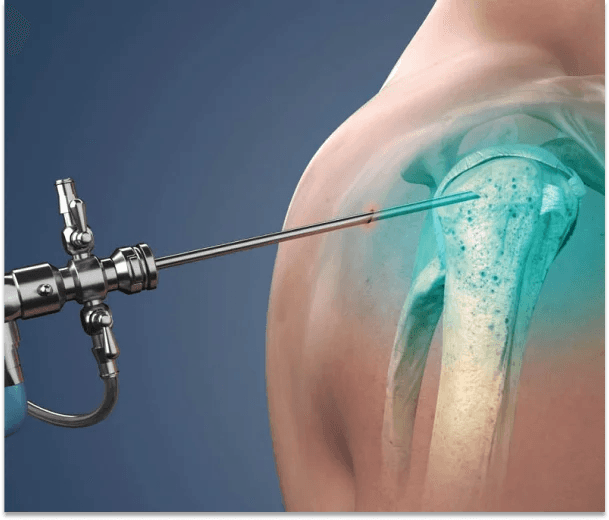
Arthroscopic Capsular Release
Under arthroscopic (keyhole) visualisation, the surgeon uses a radiofrequency probe or scissors to divide the contracted capsular tissue in a controlled, systematic way. The advantage over MUA is that the release is precise — targeted to the most contracted areas, with real-time visualisation preventing injury to surrounding structures.
Arthroscopic capsular release is performed at Sarvodaya Healthcare in Noida and produces excellent outcomes for refractory frozen shoulder — most patients achieve significant range-of-motion improvement within weeks of surgery, which is then consolidated with intensive post-operative physiotherapy.
Frozen Shoulder in Diabetic Patients: Special Considerations
Diabetic frozen shoulder is a distinct clinical entity — more painful, more prolonged, more resistant to treatment, and more likely to have bilateral involvement (both shoulders) than idiopathic frozen shoulder. Diabetes-related frozen shoulder can take 3 to 5 years to resolve even with appropriate treatment.
For Indian diabetic patients with frozen shoulder:
- Blood glucose control directly affects the course of the condition — poorly controlled diabetes appears to worsen and prolong frozen shoulder
- Multiple steroid injections may need to be given with additional caution given the glucose-raising effect of corticosteroids (which typically lasts 3 to 7 days after injection)
- Response to treatment is slower and more incomplete than in non-diabetic patients
- The threshold for considering hydrodilatation or arthroscopic release is lower — conservative management success rates are reduced
What Not To Do
Force through a painful range: Many Indian patients are advised to "do the exercises even if it hurts." In Stage 1, forcing movement through pain genuinely worsens the inflammatory process. Pain at end-range stretch in Stage 2 is more acceptable — mild discomfort during stretch is appropriate, sharp pain is not.
Apply heat in Stage 1: Heat increases blood flow and can amplify the inflammatory process in the active Stage 1. In Stage 2, warmth before stretching makes the capsule more pliable and is helpful.
Rest completely: Pendulum exercises, gentle assisted movement, and activity within the pain-free range should be maintained even in Stage 1. Complete rest allows the adhesions to consolidate.
Wait indefinitely without specialist input: Frozen shoulder that is not improving after 3 months of physiotherapy, or that is causing severe sleep disruption, warrants specialist assessment and consideration of injection treatment.
Frequently Asked Questions
How long does frozen shoulder last? The natural history of untreated frozen shoulder ranges from 18 months to 3 years. With appropriate staged treatment — injection in Stage 1, physiotherapy and possible hydrodilatation in Stage 2, surgery for refractory cases — this timeline can be significantly shortened and the risk of residual permanent restriction reduced.
Is frozen shoulder the same as rotator cuff tear? No. Rotator cuff tear restricts active movement (the patient cannot raise their arm) but passive movement is preserved (the doctor can move the arm easily). Frozen shoulder restricts both active and passive movement — the shoulder is physically blocked in all planes.
Will my frozen shoulder come back after treatment? Recurrence in the same shoulder is uncommon (about 5 percent). However, the other shoulder develops frozen shoulder in approximately 17 percent of patients within 5 years — which is why identifying and managing risk factors (particularly diabetes control) is worthwhile.
Dr. Ankur Singh | Shoulder Specialist Noida | Frozen Shoulder Treatment India | Shoulder Arthroscopy Sarvodaya Healthcare | Renew Orthopedic Clinic Sector 47 Noida
Medical Disclaimer
The information provided on this website is for educational purposes only and should not be considered as medical advice. Please consult Dr. Ankur Singh or a qualified healthcare professional for personalized medical guidance.
Share this blog:
 Copy