What Happens During Hip Replacement Surgery: A Step-by-Step Guide

A straightforward total hip replacement takes about 60 to 90 minutes.
The operating theatre before a hip replacement looks unfamiliar. The equipment is unrecognisable. The procedure — removing the diseased femoral head and replacing it with metal and ceramic or polyethylene — is something most patients have no reference point for. The unfamiliar is almost always more frightening than the understood.
This guide eliminates that unfamiliarity. Everything that happens, from the moment you arrive at Sarvodaya Healthcare in Noida to the moment you wake up in the recovery room, is described here in plain language. By the time you read this, the operating theatre will be a place you can picture — not a source of anxiety.
The Day Before Surgery
For planned total hip replacement at Sarvodaya Healthcare, patients are typically admitted the evening before surgery or early morning on the day of surgery.
What happens on admission:
- Blood tests: haemoglobin, clotting, blood group, kidney function, blood glucose
- Chest X-ray and ECG
- Anaesthesia pre-assessment: the anaesthesiologist reviews your medical history, current medications, and anaesthetic plan
- Diabetic patients: blood glucose monitoring begins, with adjustments to insulin or oral medication as needed
- Skin preparation: the surgical site (hip area) may be cleaned and hair removed if necessary
- Fasting instructions: typically nothing to eat from midnight; clear fluids usually allowed until 2 hours before surgery
The Morning of Surgery: The Pre-Operative Area
You are transferred from the ward to the pre-operative area adjacent to the operating theatres. An intravenous line is placed in the hand or forearm. Pre-operative antibiotics are given through the drip — delivered before skin incision, this is a critical infection-prevention step.
The anaesthesiologist places your spinal anaesthetic. For hip replacement, the same technique as knee replacement is used: a fine needle is placed between the vertebrae in the lower back, delivering local anaesthetic into the spinal fluid. Within 3 to 5 minutes, the legs are numb from the waist down. Sedation is given through the IV line — most patients are drowsy, comfortable, and remember very little of the procedure itself.
Inside the Operating Theatre
The Environment
A laminar flow operating theatre: filtered, positively pressured air that dramatically reduces airborne bacteria and infection risk. Cool, brightly lit, with the operating table at the centre. Five to six people in the room — the surgeon, a surgical assistant, the anaesthesiologist, a scrub nurse, and a circulating nurse.
Positioning: The Lateral Decubitus Position
For most hip replacements (posterior or direct lateral approach), you are positioned lying on your side — the operated hip uppermost. Padded supports hold the pelvis secure. The non-operated leg rests on a padded support below. The operated leg is draped free, allowing the surgeon to move it through its range during the procedure.
The specific position matters clinically — correct positioning ensures that the cup can be placed at the planned angle in both planes. In robotic hip replacement, reference trackers attached to the pelvis measure the exact orientation throughout the procedure.
The Surgical Approach
Posterior approach (most widely used): An incision of 12 to 15 cm along the outer and posterior hip, between the gluteus maximus fibres. The short external rotator muscles at the back of the hip are detached from the femur, allowing access to the hip capsule. The capsule is opened, exposing the diseased femoral head.
Anterolateral approach (direct lateral or Hardinge): An incision along the outer hip with partial detachment of the gluteus medius. Less dislocation risk than posterior but different muscle anatomy.
Anterior approach: Incision at the front of the hip, working between muscle planes without detaching any muscle. Faster recovery and no posterior hip precautions needed — but technically more demanding. Available at centres with specific anterior approach experience.
Dr. Ankur Singh discusses the planned approach and its specific implications for the patient's recovery and activity profile at the pre-operative consultation.
Step 1: Exposing the Hip Joint
Once the capsule is opened, the femoral head — deformed, arthritic, often with bone spurs and loss of normal spherical shape — is visible. The leg is internally rotated to bring the hip to the point of dislocation. The femoral head is dislocated out of the acetabulum (the socket) and held by the surgical assistant.
Step 2: Femoral Head Removal
A reciprocating saw cuts across the femoral neck at the planned angle and level. The diseased femoral head is removed from the operating field. Looking at the exposed cut surface of the femoral neck, the operating team can directly assess bone quality, the cut angle, and whether the cut is at the correct level.
Step 3: Acetabular Preparation
With the femoral head removed, the acetabulum is fully accessible. Sequential reamers — hemispherical cutting tools of progressively increasing diameter — are used to remove the arthritic acetabular cartilage and shape the socket to receive the cup. The goal is a precisely spherical cavity at the planned diameter.
In robotic hip replacement, the reaming direction is guided by the robotic system in real time, confirming that the cup will be placed at the planned abduction angle and anteversion angle — the two measurements most critical for hip stability and long-term function.
Step 4: Acetabular Cup Placement
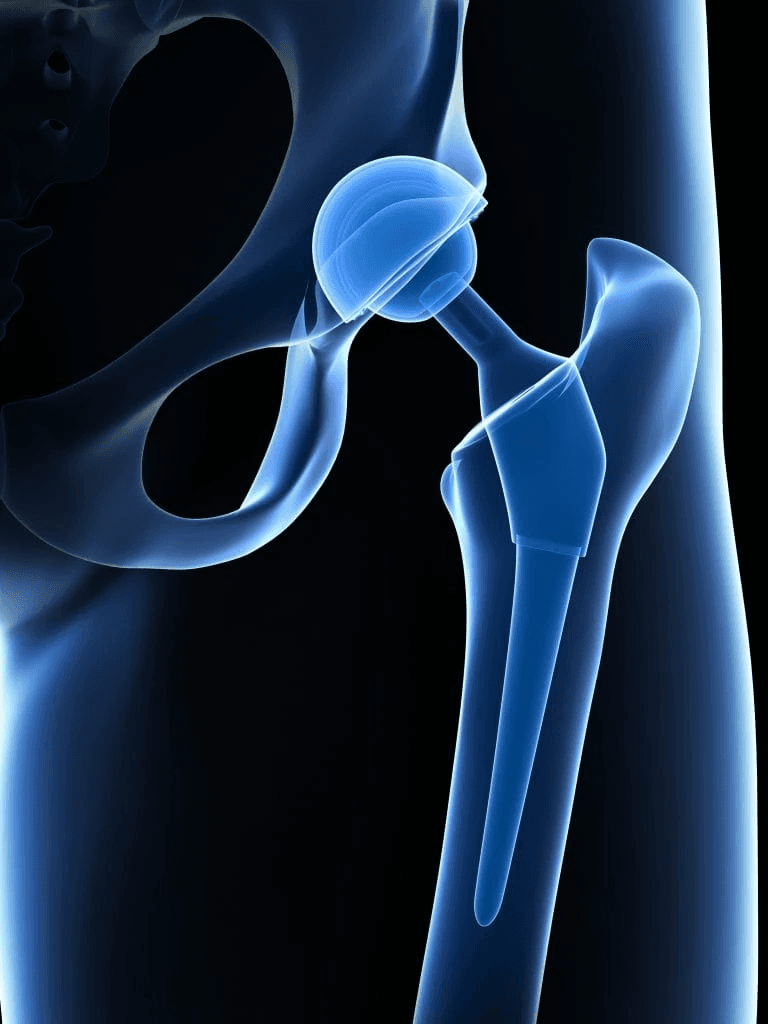
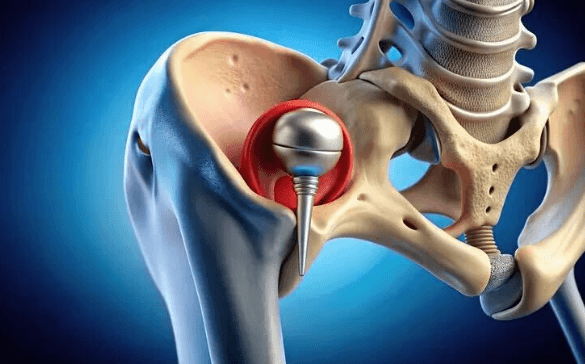
The acetabular cup — a hemispherical metal shell — is press-fit (hammered into the prepared socket) and locks by contact friction against the surrounding bone. Additional screws may be placed for added stability.
Inside the metal shell sits the liner — made of highly cross-linked polyethylene (plastic), ceramic, or metal, depending on the bearing combination selected. The cup, correctly positioned, will receive the femoral head component and allow smooth movement.
In robotic hip replacement, the cup position is verified by the tracking system before final impaction — confirming alignment is within 1 to 2 degrees of the planned target. This verification is the step that makes robotic hip replacement meaningfully different from conventional surgery.
Step 5: Femoral Preparation
Attention turns to the femur (thigh bone). The exposed femoral canal is opened and progressively rasped (enlarged) with rasps of increasing size, following the anatomy of the medullary canal. Trial stems and heads are placed to assess leg length, hip stability, and offset.
The leg is moved through flexion, extension, rotation, and adduction — checking for stability and for impingement between the components. This is the moment that determines whether the hip will feel correct and remain stable after surgery.
Step 6: Final Component Implantation
The trial components are removed. The definitive femoral stem is inserted — either cemented (a bone cement polymer locks the stem in the canal) or cementless (the stem is press-fit into the bone and bone grows into its porous surface over weeks). The head component is placed onto the femoral stem.
The hip is reduced (the head placed back into the cup). A final range of motion assessment confirms stability in all functional positions, including the positions of daily Indian life that were discussed at the pre-operative planning stage.
Step 7: Closure
The detached muscles (if posterior or anterolateral approach) are repaired to their attachment points. The joint capsule is closed. The soft tissue layers are closed sequentially. A drain may be placed to remove post-operative blood collection. Dressing applied.
The entire procedure takes approximately 60 to 90 minutes for a straightforward hip replacement. Bilateral simultaneous replacement takes 100 to 140 minutes.
Recovery Room: 1 to 2 Hours
You are transferred to the recovery room. The nursing team monitors pulse, blood pressure, oxygen, and the operative site while the spinal anaesthetic wears off. Pain medication is given proactively through the drip before the spinal fully wears off — to avoid a sharp transition from numb to painful.
As sensation returns to the legs over 2 to 4 hours, pain management is maintained with oral or intravenous medications. Most patients describe the immediate post-operative phase as uncomfortable but manageable — less severe than the arthritic pain they lived with before surgery.
What to Expect in the Ward: Day 1
On the day after surgery, the physiotherapist visits. The first hip replacement exercises — ankle pumps, quad sets, breathing exercises — begin while still in bed. Standing and taking the first steps with a walking frame is attempted on Day 1 in most patients.
The hip dislocation precautions — which positions to avoid based on the surgical approach — are taught before discharge and practised during the hospital stay. These precautions are position-specific: posterior approach patients avoid excessive internal rotation and flexion beyond 90 degrees; anterior approach patients have fewer restrictions.
Hospital discharge is typically Day 3 to 5. Discharge criteria: pain controlled with oral medications, walking with a frame safely, wound clean and dry, blood parameters satisfactory.
Frequently Asked Questions
Will I be awake during hip replacement? With spinal anaesthesia and sedation, you are conscious but profoundly drowsy and will feel nothing from the waist down. Most patients have little memory of the procedure itself. If you prefer to be more deeply sedated, discuss this with the anaesthesiologist — this is adjusted based on patient preference.
How long is the scar from hip replacement? The standard posterior or anterolateral approach produces a scar of approximately 12 to 15 cm. Minimally invasive techniques can reduce this to 8 to 10 cm. The scar is on the outer or posterior hip — not visible in normal clothing.
How soon after surgery can I fly? Short domestic flights (1 to 2 hours): typically from 6 to 8 weeks, with movement every 30 minutes during the flight. Long-haul international flights: from 3 months. Blood clot risk is elevated after hip replacement surgery and is the main concern with early air travel.
Dr. Ankur Singh | Hip Replacement Surgeon Noida Greater Noida | Hip Surgery Procedure India | Sarvodaya Healthcare | Renew Orthopedic Clinic Sector 47 Noida
Medical Disclaimer
The information provided on this website is for educational purposes only and should not be considered as medical advice. Please consult Dr. Ankur Singh or a qualified healthcare professional for personalized medical guidance.
Share this blog:
 Copy




-compressed (2).jpg)