Patellar tendinitis: causes, symptoms, and treatment for knee pain

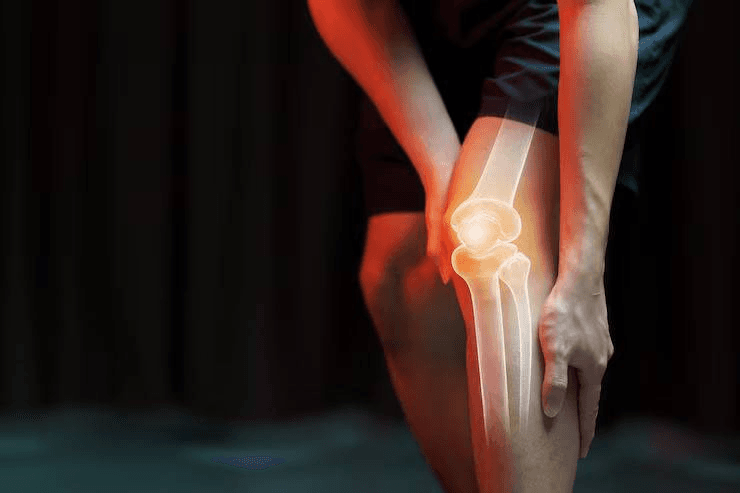
Athlete holding swollen knee joint due to patellar tendinitis causing knee pain
Patellar tendinitis, often called "jumper's knee", is one of the most common overuse injuries I see in active patients. It affects the patellar tendon, which connects the bottom of your kneecap (patella) to the top of your shinbone (tibia). This tendon works every time you straighten your knee — jumping, running, kicking, climbing stairs, even standing up from a chair.
The name "jumper's knee" comes from its prevalence in basketball and volleyball players, but I see it just as often in recreational runners, gym enthusiasts doing heavy squats, and even middle-aged patients who suddenly increase their activity level. About 1 in 5 athletes in jumping sports will deal with this condition at some point.
What causes patellar tendinitis?
The patellar tendon handles enormous forces. During a jump landing, it absorbs forces up to 8 times your body weight. Even during normal stair climbing, the load is 3-4 times body weight.
Tendinitis develops when the repetitive loading outpaces the tendon's ability to repair itself. Micro-tears accumulate in the tendon fibers. Initially, there's inflammation (tendinitis). If the loading continues without adequate recovery, the tendon undergoes structural degeneration at the cellular level, a condition called tendinosis, where the tendon tissue becomes disorganized and weakened.
Common risk factors:
- Sudden increase in activity: Starting a new exercise routine, increasing running distance by more than 10% per week, or adding jumping drills without gradual progression
- Tight quadriceps and hamstrings: Tight muscles increase the tension on the patellar tendon
- Weak quadriceps or gluteal muscles: The tendon overworks when the muscles can't absorb their share of the load
- Hard playing surfaces: Concrete courts, hard running surfaces
- Poor footwear: Worn-out shoes with inadequate cushioning
- Leg alignment issues: Flat feet, knock knees, or patellar tracking problems increase stress on the tendon
- Body weight: Higher body weight = higher forces through the tendon with every step
Symptoms: what patellar tendinitis feels like
The hallmark symptom is pain at the bottom of the kneecap, right where the tendon attaches to the patella. But the pattern evolves through stages:
Stage 1: pain only after activity
Pain appears after exercise or activity, not during it. The knee feels fine while playing or running, but aches afterward. Most people dismiss this as normal post-exercise soreness. This is the easiest stage to treat — and the one most people ignore.
Stage 2: pain during and after activity
Pain shows up during activity but doesn't limit performance yet. You can push through it, but the knee hurts more afterward. You might notice it specifically when jumping, landing, or going downstairs.
Stage 3: pain that limits activity
Pain is present during activity and starts affecting performance. You can't jump as high, you're hesitant to sprint, and certain exercises become too painful to complete. Daily activities, squatting, kneeling, prolonged sitting, become uncomfortable.
Stage 4: complete tendon failure
If the tendon degenerates severely without treatment, partial or complete rupture can occur. This is rare but represents the end stage — it typically requires surgical repair.
Diagnosis
I can usually diagnose patellar tendinitis through examination alone:
Physical findings:
- Point tenderness at the inferior pole of the patella (the bottom edge of the kneecap). This is very specific, I press exactly on the tendon attachment, and the patient confirms that's the spot.
- Pain with resisted knee extension (straightening the knee against resistance)
- Pain with single-leg squat or decline squat
- Possibly mild swelling around the tendon
- Full range of motion is usually preserved
Imaging (when needed):
- Ultrasound: My preferred imaging tool for tendon problems. Shows tendon thickening, tears, and areas of degeneration in real time. Also useful for guided injections.
- MRI: Shows tendon pathology clearly. I order this when symptoms are severe, if there's concern about other knee pathology (meniscus tear, cartilage damage), or before surgical planning.
- X-rays: Don't show soft tissue well, but useful to rule out bone pathology. May show calcification within the tendon in chronic cases.
Treatment: A staged approach
Acute phase (Weeks 1-3): reduce pain
Modify activity, don't stop moving. Stop the aggravating activity (jumping, running, deep squats) but maintain general fitness through activities that don't load the tendon as heavily, swimming, cycling, upper body strength work.
Ice: 15-20 minutes after activity, 2-3 times daily.
NSAIDs: A short course (5-7 days) can help manage acute pain. Topical diclofenac gel applied directly over the tender area works well.
Patellar tendon strap: A band worn just below the kneecap distributes force away from the tendon insertion. It doesn't cure anything, but many patients find it reduces pain during activity. Costs Rs 300-800 and is worth trying.
Rehabilitation phase (Weeks 3-12): The core of treatment
Eccentric exercises are the gold standard. This is the single most important treatment for patellar tendinitis. The evidence supporting eccentric loading for tendon rehabilitation is strong and consistent.
Decline squat protocol: Stand on a 25-degree decline board (or a wedge). Do a single-leg squat, lowering slowly over 3-5 seconds to about 60-70 degrees of knee bend. Use the other leg to return to standing. Start with 3 sets of 15 repetitions, twice daily. Expect some pain during the exercise (up to 4-5 out of 10) — this is acceptable and even desirable. The exercise stimulates tendon remodeling at the cellular level.
If you don't have a decline board, heavy slow resistance training (HSR) is equally effective: squats, leg press, and leg extension performed slowly (3 seconds up, 3 seconds down) with progressively increasing weight. 3 sessions per week.
Supporting exercises:
- Quadriceps strengthening (straight leg raises, wall sits)
- Hamstring stretches (30 seconds, 3 times daily)
- Gluteal strengthening (bridges, clamshells)
- Calf raises
- Core stability work
Advanced interventions (If rehabilitation plateaus)
If 12 weeks of disciplined eccentric exercise doesn't produce adequate improvement:
Shockwave therapy (ESWT): 3-5 sessions, one week apart. Stimulates healing response in the degenerated tendon. I've seen good results in about 60-70% of chronic cases that haven't responded to exercises alone.
PRP injection (Platelet-Rich Plasma): An injection of your own concentrated platelets into the tendon. The growth factors stimulate tendon repair. Recovery takes 4-6 weeks after injection. Evidence is growing, particularly for chronic tendinopathy.
Corticosteroid injection: I use this very sparingly for patellar tendinitis. While it provides quick pain relief, steroids can weaken tendon tissue and increase the risk of rupture. It's occasionally justified for severe acute pain but should not be repeated.
Surgery (Last resort)
Surgery is considered only after 6-12 months of failed conservative treatment. Options include:
- Arthroscopic debridement of the degenerated tendon tissue
- Open patellar tendon excision and repair
- Ultrasound-guided percutaneous tenotomy
Success rates are about 75-85%, but recovery takes 4-6 months, and return to full sport takes 6-12 months. Surgery is genuinely a last resort, most patients never need it.
Recovery timeline
With proper treatment:
- Mild cases (Stage 1): 4-6 weeks
- Moderate cases (Stage 2): 8-12 weeks
- Chronic cases (Stage 3): 3-6 months
- Post-surgical: 6-12 months
The most common mistake I see is patients stopping exercises as soon as the pain improves. Tendon remodeling takes time, even after pain resolves, the tendon needs continued loading to fully reorganize its structure. I recommend continuing the eccentric exercise program for at least 4-6 weeks after becoming pain-free.
Prevention
- Increase training volume gradually — the 10% rule applies to running distance, jumping volume, and weight room loads
- Warm up properly before explosive activities
- Maintain flexible quadriceps and hamstrings
- Strengthen gluteals and core, strong proximal muscles reduce tendon loading
- Use appropriate footwear with adequate cushioning for your sport
- Don't train through significant knee pain, early modification prevents chronic problems
- Cross-train to avoid repetitive loading (alternate running days with swimming or cycling)
When to See a doctor
- Knee pain at the front of the kneecap lasting more than 2 weeks
- Pain that's getting worse despite rest
- Swelling around the kneecap
- Inability to straighten or fully bend the knee
- Sudden sharp pain with a "pop" (possible tendon tear — needs urgent evaluation)
- Pain limiting your daily activities or sport participation
Patellar tendinitis is frustrating because it's slow to heal, but it's very treatable when approached correctly. The key is not just managing the pain, but rehabilitating the tendon through progressive loading. Skip the quick fixes, commit to the eccentric program, and the tendon will heal.
Medical Disclaimer
The information provided on this website is for educational purposes only and should not be considered as medical advice. Please consult Dr. Ankur Singh or a qualified healthcare professional for personalized medical guidance.
Share this blog:
 Copy
Copy



.jpg)
/doctor-hospital-room-with-knee-injury-compressed.jpg)