Bilateral Knee Replacement: Should Both Knees Be Done At The Same Time?

A healthcare professional examining a knee after surgery during recovery.
It is one of the most common situations in knee replacement practice: a patient sits across the desk with X-rays showing advanced arthritis in both knees. One knee may be slightly worse than the other, or both may be equally destroyed. Either way, the question that follows is always the same: "Can we do both at once? Or does one have to come first?"
This is a genuinely important decision, and it deserves a real answer, not a vague recommendation driven by convenience or habit. Whether both knees should be replaced simultaneously or in separate surgeries depends on who the patient is, what their overall health looks like, and what their recovery circumstances will be. Here is what the evidence shows, and how Dr. Ankur Singh approaches this decision for patients in Noida and Greater Noida.
What Is Bilateral Knee Replacement?
Bilateral knee replacement means replacing both knee joints on both sides as part of the treatment for bilateral osteoarthritis. It is more common than many patients realise: studies consistently show that 15 to 20 percent of all knee replacement patients have significant arthritis in both knees at the time of surgery. There are two distinct approaches:
Simultaneous bilateral knee replacement - Both knees are replaced in a single operation, under one anaesthetic, on the same day.
Staged bilateral knee replacement - Each knee is replaced in a separate surgery, typically three to six months apart (though the interval can vary).
Both approaches produce the same long-term outcome. The difference lies in the risk profile, the recovery experience, and the practical burden on the patient.
The Case For Simultaneous (Both At Once)
For the right patient, doing both knees in one operation has clear advantages.
One anaesthetic, one recovery period. The most obvious benefit is that the patient goes through the surgical and rehabilitation process only once. Instead of two hospital admissions, two post-operative periods, and two rounds of physiotherapy, everything is consolidated into a single episode of care.
Less total time off work. For working-age patients in Noida, professionals, business owners, and people who cannot afford two extended absences, this matters significantly. One recovery period of three to four months is more manageable than two separate periods, adding up to five to seven months.
Cost efficiency. A single hospital admission, single set of surgical consumables, and a single physiotherapy course reduce the overall financial burden compared to two separate procedures. In India's context, where a significant proportion of patients pay out of pocket, this is a real consideration.
No "good knee, bad knee" imbalance. When one knee is replaced, and the other is not yet treated, the unaffected side compensates heavily during rehabilitation. This can cause overloading of the unreplaced knee and create an asymmetrical gait pattern. Replacing both simultaneously avoids this.
Similar long-term outcomes. Research consistently shows that pain relief, functional outcomes, and patient satisfaction at one year and beyond are equivalent between simultaneous and staged surgery. The result is the same; the path to get there differs.
The Case For Staged (One At A Time)
Staged surgery is not the "less aggressive" or less effective option; it is the safer option for a specific group of patients, and for them it is clearly the right choice.
Lower cardiovascular and thromboembolic risk. Simultaneous bilateral knee replacement is a significantly larger physiological event than a single knee replacement. The combined blood loss, anaesthetic duration, and inflammatory response from two joints being operated simultaneously place a greater demand on the heart, lungs, and clotting system. Studies show higher rates of blood transfusion, venous thromboembolism (deep vein clots and pulmonary embolism), and cardiac events in simultaneous bilateral surgery compared to staged procedures, particularly in patients with pre-existing heart or lung conditions.
More manageable rehabilitation. When both knees are operated on simultaneously, the patient has no functional "good leg" to lean on during the early recovery phase. Getting up from a chair, navigating to the bathroom, and managing basic mobility requires assistance for longer periods. For elderly patients, those with limited upper body strength, or those without intensive home support, this is a genuine hardship. With staged surgery, the first knee is significantly recovered before the second is operated on, making the second recovery far less challenging.
Appropriate for higher-risk patients. The American Association of Hip and Knee Surgeons (AAHKS) recommends that simultaneous bilateral knee replacement be reserved for patients who are relatively young, medically fit, not obese, and without significant cardiopulmonary comorbidities. For patients who do not meet these criteria, which includes a large proportion of elderly Indians with hypertension, diabetes, and heart disease, staged surgery is not a compromise. It is the correct clinical decision.
Who Is The Right Candidate For Simultaneous Bilateral Replacement?

Senior man sitting on a couch holding his knee in pain, showing signs of chronic joint discomfort before knee replacement surgery.
Dr. Ankur Singh carefully evaluates each patient against the following criteria before recommending simultaneous surgery:
- Age under 70 (younger patients have more physiological reserve to handle the larger surgical burden)
- ASA grade 1 or 2 (low to moderate anaesthetic risk, no significant cardiac, respiratory, or renal disease)
- BMI below 35 (severe obesity increases both surgical and recovery risk)
- No significant history of blood clots, stroke, or cardiac events
- Strong home support system - A family member or caregiver who can assist through the more demanding early recovery phase.
- Strong patient motivation - Simultaneous recovery requires more effort from the patient.
If a patient has diabetes, hypertension, or chronic kidney disease but these are well-controlled, and the patient is otherwise fit, simultaneous surgery may still be considered with appropriate pre-operative optimisation and anaesthetic planning.
What Recovery Looks Like: Simultaneous Vs Staged
Simultaneous bilateral:
- Hospital stay: Typically 5 to 7 days
- First 6 weeks: Significantly more challenging, both knees swollen, stiff, and painful simultaneously; full-time physiotherapy essential.
- By 12 weeks: Most patients have caught up to where a single knee replacement patient would be at the same stage.
- Full recovery: 4 to 6 months
Staged bilateral:
- First surgery: Hospital 3 to 4 days, recovery 3 to 4 months before second surgery.
- Second surgery: Similar hospital stay; often easier than the first because the patient knows what to expect and is generally fitter from the rehabilitation of the first knee.
- Total time from first surgery to full bilateral recovery: 7 to 10 months
The Role Of Robotic-Assisted Surgery In Bilateral Replacement
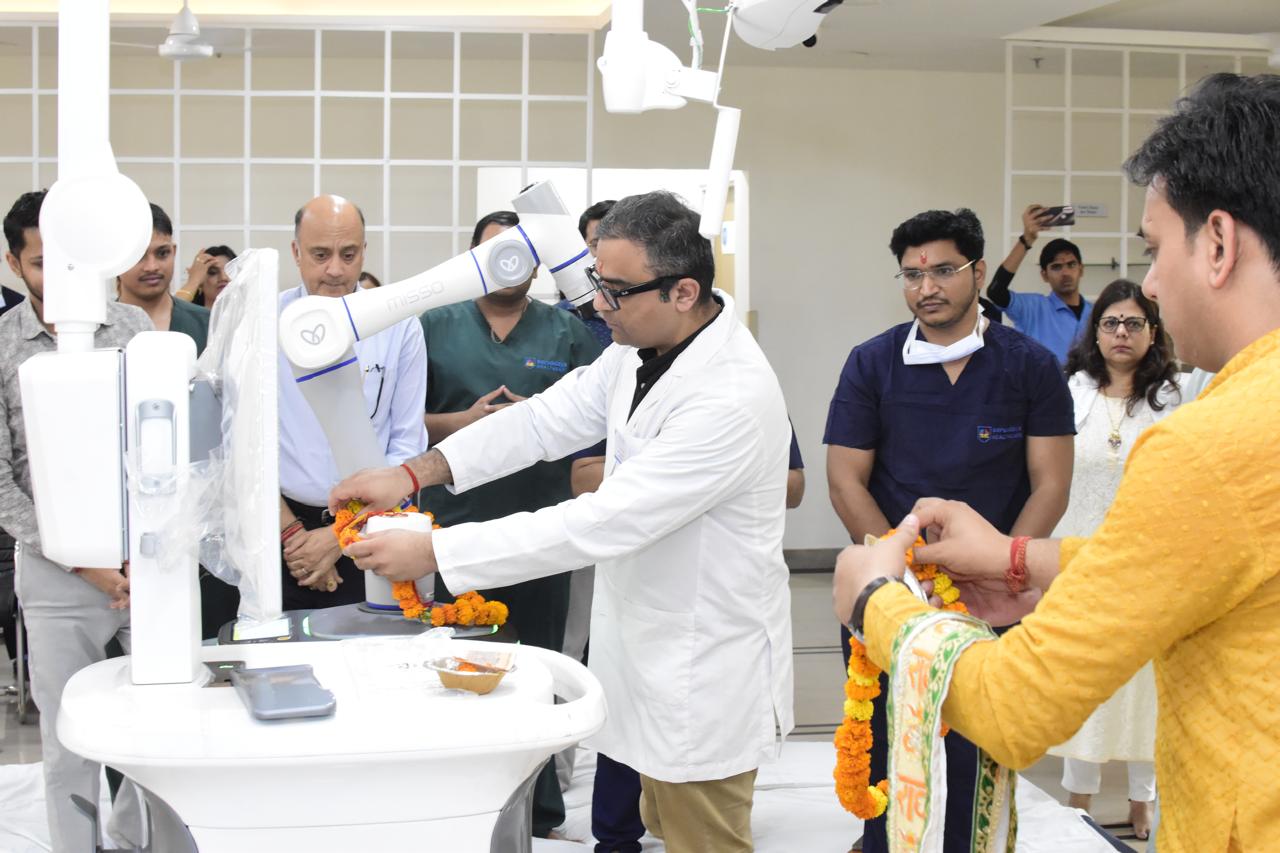
Whether bilateral knee replacement is done simultaneously or staged, robotic-assisted surgery at KDSG Superspeciality Hospital in Greater Noida offers a meaningful advantage in the accuracy of implant positioning. When both implants are placed with millimetre precision using pre-operative 3D planning and real-time robotic guidance, the mechanical alignment across both knees is optimised, which matters for long-term implant function and wear. For younger patients choosing simultaneous bilateral replacement, this precision is especially valuable. Their implants need to last 20 to 25 years or longer, and accurate positioning is the most important factor in achieving that longevity.
The Honest Bottom Line

A healthcare professional in scrubs holding a knee joint model with ligaments and artificial parts moving, and great detail of the structure and ligament position.
Both approaches work well when matched to the right patient. The decision is not about which is "better" in absolute terms; it is about which is appropriate for you. If you are under 65, medically fit, have strong home support, and both knees are severely arthritic, simultaneous bilateral replacement is worth discussing seriously. You go through surgery once, recover once, and move forward with both knees restored at the same time.
If you have significant medical comorbidities, are older, live alone, or have limited support at home, staged surgery is not a compromise; it is the smarter choice. The second recovery is markedly easier than the first, and the long-term outcomes are identical. To discuss your specific situation and which approach is appropriate for your case, book a consultation with Dr. Ankur Singh at Renew Orthopedic Clinic, Sector 47, Noida, or call the number listed on this website.
Frequently Asked Questions
1. How far apart should staged bilateral knee replacements be?
Most surgeons recommend three to six months between staged procedures. This allows the first knee to recover sufficiently for the patient to be in good physical condition before the second surgery. Risks of performing the second surgery earlier than three months include the second surgery being performed while the patient is still significantly deconditioned from the first.
2. Is simultaneous bilateral knee replacement more expensive?
A single hospital stay and one surgical episode are generally more cost-efficient overall than two separate admissions. However, the first admission for simultaneous surgery is longer than for a single knee replacement. The exact financial comparison depends on the individual hospital and insurance situation.
3. Can robotic surgery be used for bilateral replacement?
Yes. At KDSG Superspeciality Hospital in Greater Noida, Dr. Ankur Singh performs robotic-assisted knee replacement for both single and bilateral cases. For simultaneous bilateral procedures, both knees are planned pre-operatively using 3D imaging, and each is executed with robotic guidance during the same session.
4. What if one knee is much worse than the other?
In most cases, both knees are still replaced rather than just the worse one, because significant arthritis in the second knee will typically cause symptoms within months of the first surgery, leading to a second procedure anyway. The exception is where one knee is early-stage, and the patient is genuinely asymptomatic on that side.
Dr. Ankur Singh | Best Orthopedic Surgeon in Noida | Bilateral Knee Replacement | Robotic Knee Replacement Greater Noida | Renew Orthopedic Clinic, Sector 47 Noida
Medical Disclaimer
The information provided on this website is for educational purposes only and should not be considered as medical advice. Please consult Dr. Ankur Singh or a qualified healthcare professional for personalized medical guidance.
Share this blog:
 Copy
Copy