Why your joints crack: normal or a sign of a problem?
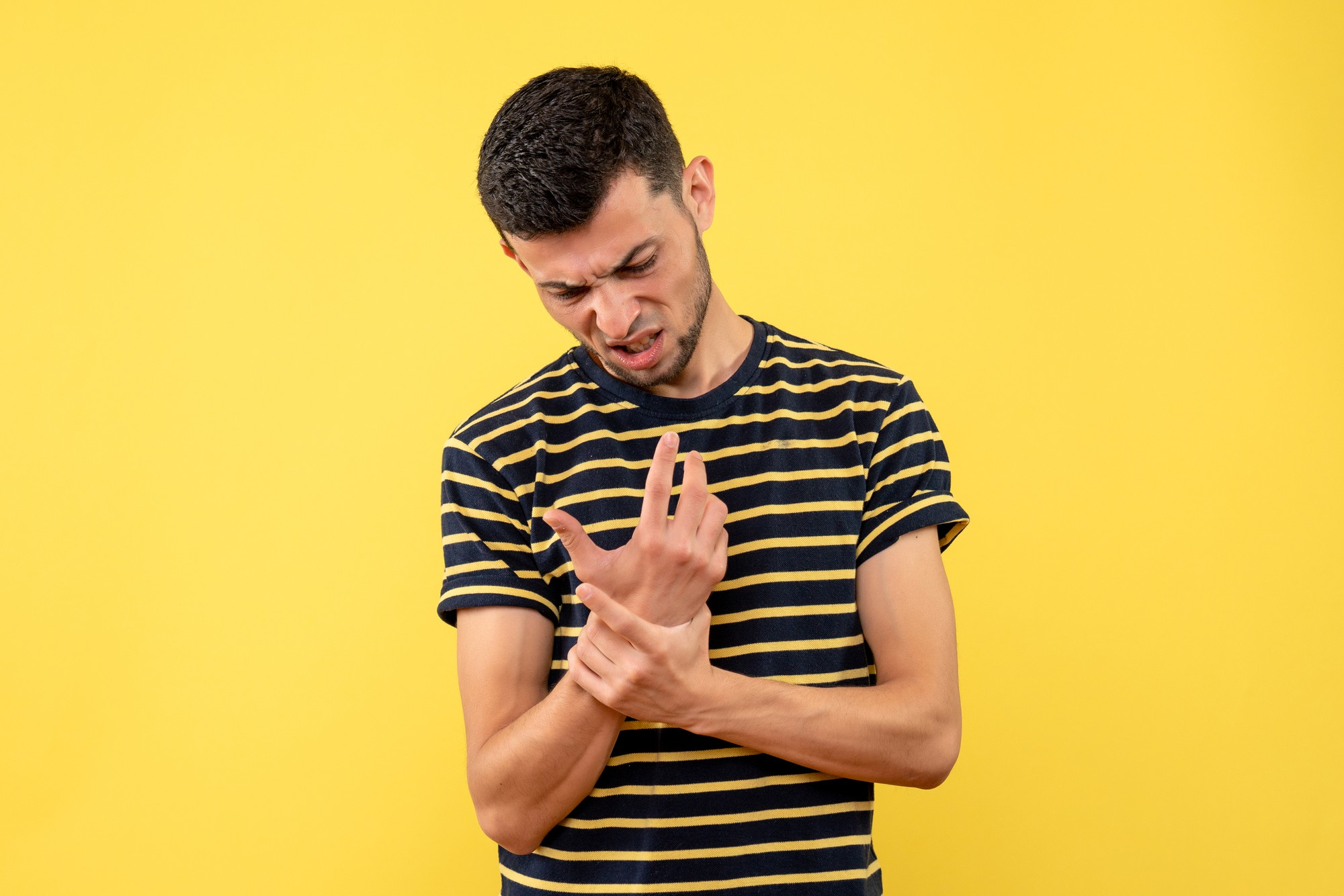
A man looking at his knuckles as they crack.
That popping sound when you stand up from a chair, the crack in your knees when you climb stairs, or the snap in your neck when you turn it, almost everyone has experienced joint cracking at some point. And almost everyone has wondered the same thing: should I be worried?
I hear this question in my clinic multiple times a day. Patients walk in genuinely anxious, thinking their joints are "wearing out" because they crack. Most of the time, I'm able to reassure them. But occasionally, joint sounds do signal something that needs attention. The trick is knowing which is which.
What actually happens when a joint cracks?
Joint sounds come from different sources, and not all of them mean trouble.
Gas bubble release (Cavitation)
Your joints are surrounded by a capsule filled with synovial fluid, a thick, slippery liquid that works like engine oil for your body. This fluid contains dissolved gases (mostly carbon dioxide and nitrogen).
When you stretch or bend a joint quickly, the pressure inside the capsule drops. That pressure change lets tiny gas bubbles form and then collapse almost instantly. The "pop" you hear? That's the bubble collapsing. It's the same basic principle as opening a soda bottle.
This is completely harmless. Once the gas re-dissolves — which takes about 20 minutes, the joint can crack again. That's why you can't usually crack the same knuckle twice in a row.
Tendons and ligaments snapping over bone
Sometimes the sound isn't coming from inside the joint at all. Tendons (which connect muscle to bone) and ligaments (which connect bone to bone) can shift slightly during movement and snap back over a bony surface.
This is especially common in:
- The hip, where the IT band slides over the greater trochanter
- The shoulder — where the biceps tendon can click over the groove
- The knee, where the patellar tendon shifts during bending
- The ankle, where the peroneal tendons pop over the outer ankle bone
If there's no pain, this kind of snapping is usually nothing to worry about.
Rough cartilage surfaces
As we age, cartilage — the smooth, rubbery coating on the ends of bones, starts to lose its even texture. When slightly roughened cartilage surfaces glide against each other, they can produce a grinding or crunching sensation called crepitus. You might feel this in your knees when you go up and down stairs. In about 4 out of 10 people over age 40 who come to my clinic, I can feel crepitus in the knees during examination. Many of them have zero pain.
Stiffness after inactivity
Sat through a 3-hour flight? Slept in one position all night? When joints stay still for extended periods, the surrounding tissues tighten up and synovial fluid thickens slightly. Your first few movements after that produce cracking or popping as everything loosens up. Perfectly normal.
When joint cracking Is harmless
Most of the time, joint cracking is no cause for concern. Here's a quick self-check:
- No pain during or after the crack
- No swelling, redness, or warmth
- Full range of movement, no restriction
- The cracking doesn't get worse over time
- No history of injury to that joint
If all five are true, you're almost certainly fine. Your joints are just doing their thing.
I'll sometimes demonstrate to patients by cracking my own knuckles in the clinic. It helps them relax a bit.
When It could signal a problem
That said, not all joint sounds are innocent. Certain patterns should prompt a medical evaluation.
Cracking with pain
Pain changes everything. If your joint pops and it hurts — even slightly, it could point to:
- Tendon inflammation (tendinitis): The tendon is irritated and swollen, and it snaps more aggressively over bone
- Early osteoarthritis: Cartilage is thinning, so bone surfaces are starting to interact
- A cartilage or labral tear: Especially if there was a specific incident (a twist, a fall, a sudden movement) before the symptoms started
- An old injury acting up: Ligament tears that healed with scar tissue can create mechanical clicking
Swelling or warmth around the joint
Cracking combined with a joint that looks puffy, feels warm, or appears red is a red flag. This pattern can indicate:
- Inflammatory arthritis (like rheumatoid arthritis), typically affects both sides symmetrically and is worst in the morning
- Gout — sudden, severe swelling, often in the big toe or ankle
- Bursitis, inflammation of the fluid-filled sacs that cushion joints
- Joint infection (septic arthritis), rare, but serious. If you have a fever along with a hot, swollen joint, get to a hospital
Locking or catching
If your joint feels like it gets "stuck" mid-movement and then releases with a pop, something mechanical is going on. In the knee, this is often a meniscus tear — a piece of torn cartilage gets wedged between the joint surfaces. In the shoulder, it could be a labral tear. In the hip, loose bodies (small fragments of cartilage or bone floating inside the joint) can cause the same sensation.
These conditions usually don't resolve on their own. An MRI can clarify what's happening, and treatment options range from physiotherapy to arthroscopic surgery.
Progressive grinding that gets louder
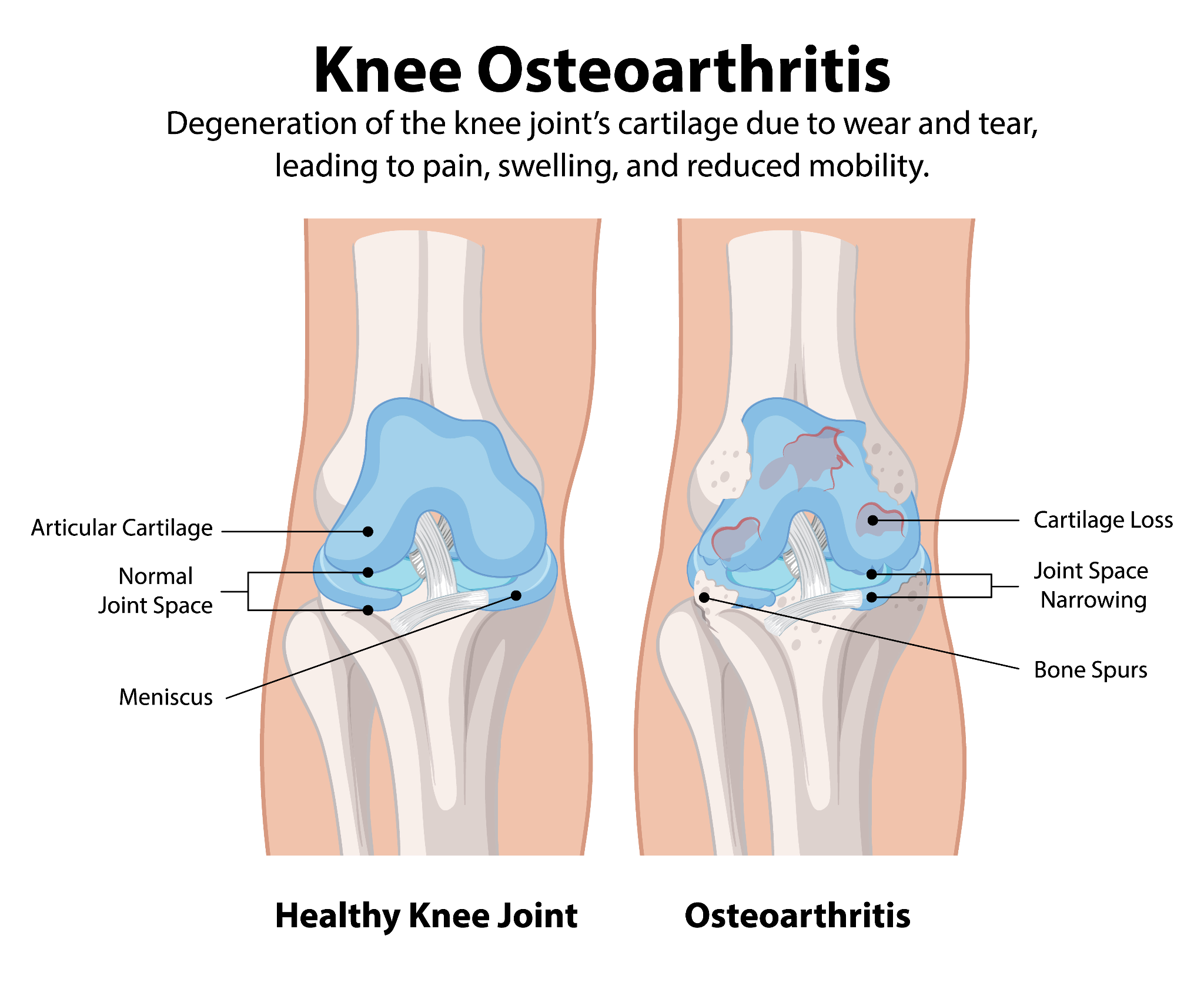
An infographic explaining knee osteoarthritis.
If the cracking sounds in a joint have been gradually getting louder, more frequent, or are now accompanied by stiffness, especially morning stiffness lasting more than 15-20 minutes, this could indicate progressive cartilage wear. An X-ray is usually the first step. If it shows narrowing of the joint space, we're looking at osteoarthritis, and early intervention can significantly slow the progression.
The knuckle-Cracking myth
One question that comes up constantly: "Will cracking my knuckles give me arthritis?"
Short answer: no.
A doctor named Donald Unger actually tested this on himself — he cracked the knuckles on one hand every day for over 60 years and left the other hand alone. The result? No difference in arthritis between the two hands. He won an Ig Nobel Prize for this in 2009.
Multiple larger studies since then have confirmed the same finding. Habitual knuckle cracking doesn't damage the joint or increase arthritis risk.
That said, aggressive or forceful cracking can occasionally strain the ligaments around the joint, leading to temporary soreness. And if cracking becomes a compulsive habit that bothers you, working on it with conscious effort is reasonable.
Conditions where joint sounds matter
Osteoarthritis
The most common reason for painful joint cracking in patients over 45. Cartilage gradually wears down, and the resulting bone-on-bone contact produces grinding sounds (crepitus). X-rays typically show joint space narrowing and small bone spurs (osteophytes). About 6 out of 10 patients I see with persistent knee crepitus and pain have some degree of osteoarthritis on imaging.
Meniscus tears
Common in active individuals. A torn meniscus can flap in and out of the joint space, causing clicking, catching, and sometimes locking. The knee may give way unexpectedly. MRI is the gold standard for diagnosis.
Patellofemoral syndrome (Runner's knee)
A crunching sensation behind the kneecap, especially when squatting, going downstairs, or sitting for long periods. The kneecap isn't tracking properly in its groove. Strengthening the inner quadriceps (VMO muscle) and using proper footwear usually helps significantly.
Shoulder impingement and rotator cuff issues
Clicking or popping in the shoulder during overhead movements can indicate that the rotator cuff tendons are getting pinched between the humerus and the acromion. If this is accompanied by pain when reaching behind your back or lifting your arm, get it evaluated before a partial tear becomes a full one.
How to keep your joints quiet and healthy
You can't eliminate all joint sounds, and you shouldn't try to. But you can reduce excessive cracking and protect your joints long-term.
Build muscle around the joint. Strong muscles act as shock absorbers. For the knee, focus on quadriceps and hamstring exercises. For the shoulder, rotator cuff strengthening. For the spine, core work. Even 15 minutes of targeted strengthening three times a week makes a measurable difference.
Stay flexible. Tight muscles and tendons pull on joints at awkward angles, increasing friction. Gentle stretching after activity, not before, when muscles are cold — reduces this. Yoga and mobility work are excellent for this.
Keep moving through the day. Joints don't like being still. If you have a desk job, stand up and move for 2-3 minutes every hour. Your joints will crack less when you finally do stand up.

A woman warming up before starting her workout.
Watch your weight. Every extra kilogram you carry puts roughly 4 kg of additional force on your knees during walking. Losing even 5 kg can dramatically reduce both cracking and pain if you have early arthritis.
Warm up before exercise. Cold muscles and tendons snap and pop more. Five minutes of light activity before a workout prepares your joints for what's coming.
Stay hydrated. Synovial fluid is your joint's natural lubricant. Dehydration makes it less effective.
When to See an orthopedic doctor
Don't ignore joint cracking if you notice any of these:
- Pain that persists for more than a week or two
- Swelling that doesn't go down with rest and ice
- Warmth or redness around the joint
- Difficulty walking, climbing stairs, or performing daily activities
- A joint that feels unstable or "gives way"
- Cracking that started after an injury or fall
- Morning stiffness lasting more than 20-30 minutes
An orthopedic evaluation usually involves a physical examination and, if needed, X-rays or an MRI. Catching problems early, before cartilage damage becomes severe, gives you far more treatment options.
Final thoughts
Joint cracking, on its own, is rarely a sign of anything serious. Your body makes noise — that's just biology. The sounds that matter are the ones paired with pain, swelling, stiffness, or a history of injury.
If your joints crack but everything moves smoothly and nothing hurts, carry on. If something doesn't feel right, don't push through it. A quick evaluation can give you either peace of mind or a head start on treatment, and both of those are worth it.
Medical Disclaimer
The information provided on this website is for educational purposes only and should not be considered as medical advice. Please consult Dr. Ankur Singh or a qualified healthcare professional for personalized medical guidance.
Share this blog:
 Copy
Copy