Loud Knees: When Clicking and Grinding Is Normal — And When It's a Warning Sign
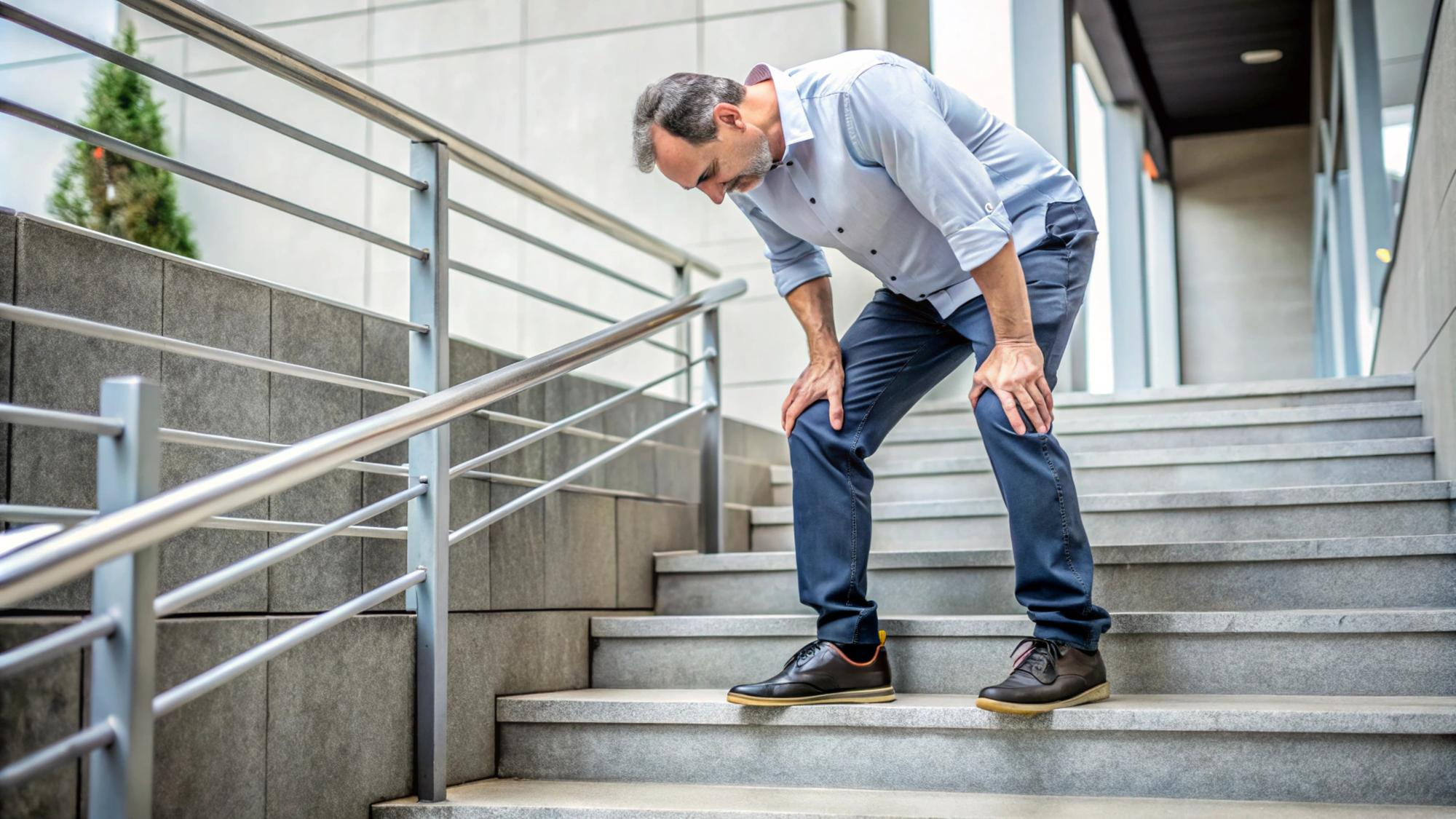
A man leaning forward while bending slightly, showing visible discomfort in the knees.
Walk up a flight of stairs in any Indian apartment building and you might hear the knees of the person ahead of you before you see them. Clicking, grinding, popping, crunching — the sounds that joints make during movement are almost universal in adults over 35, and they provoke a very consistent response: quiet anxiety about whether it means something is seriously wrong.
For the majority of people, the honest answer is: probably not. But the word "probably" matters here — because some knee sounds do indicate pathology, and the clinical distinctions between harmless noise and meaningful signal are specific enough to be worth knowing.
This guide covers the different types of knee sounds, what each is most likely to represent, and the specific combination of features that distinguishes noise worth ignoring from noise worth having assessed.
The Medical Term: Crepitus
"Crepitus" is the clinical term for any crackling, clicking, popping, or grating sensation produced by joint movement. It derives from the Latin word for rattle or creak, and it describes everything from the completely benign occasional pop of a young person's knee to the coarse bone-on-bone grating of advanced arthritis.
Crepitus is so common in the general adult population that studies using sensitive equipment can detect it in 80 to 90 percent of adults over 45 — most of whom have no significant knee symptoms. The presence of crepitus alone, in the absence of pain, swelling, or instability, is not a reliable indicator of pathology.
What matters is not the sound in isolation. It is the sound in context.
The Five Types of Knee Sound — What Each Means
1. A Single, Occasional Pop — Usually Benign
The single, infrequent pop — heard or felt once during a specific movement (standing up from a low chair, fully extending the knee after sitting) and then not again for some time — is almost certainly a gas cavitation event in the synovial fluid. Essentially the same mechanism as knuckle cracking. No structural significance.
This type of sound is particularly common in younger adults. It requires no investigation.
2. Repetitive Fine Clicking with Knee Bending — Usually Benign
A small, consistent clicking that occurs during every knee bend — perhaps noticed when climbing stairs or during exercise — is the most common form of crepitus seen in clinical practice. Under a doctor's hand, it feels like a fine, papery sensation over the front of the knee.
In the absence of pain, this type of crepitus is almost always benign. It reflects minor surface irregularities in the articular cartilage or under-surface of the patella that produce sound without causing damage. Multiple studies have shown no correlation between this type of asymptomatic crepitus and either the presence of existing arthritis or progression to arthritis over follow-up periods.
The reassuring fact: this crepitus is often louder when the joint is cold and stiff (first movement after sitting) and reduces or disappears as the joint warms up — which is characteristic of a mechanical sound from slightly viscous synovial fluid rather than structural damage.
3. Coarse Grinding or Grating — May Indicate Significant Cartilage Loss
This is qualitatively different from fine clicking. Coarse grinding — the sound of two rough surfaces moving against each other — is a different clinical finding. It is more felt than heard (though it can be audible), has a distinctive grating character, and is often most prominent when the knee is between 30 and 60 degrees of flexion under weight.
This type of crepitus, particularly when associated with any degree of pain during the movement, is more consistent with significant cartilage thinning or loss in the involved compartment. In patients over 50 who describe this as a worsening symptom over months to years — previously fine clicking that has become coarser — it warrants clinical assessment with weight-bearing X-rays.
Alone, however, it still does not mandate immediate investigation. The key question remains: is there pain with it?
4. A Painful Click or Clunk at a Specific Point in the Range of Motion — Seek Assessment
This is the sound that distinguishes itself from ambient joint noise by being painful. A click that hurts — specifically at one point in the range of motion (most commonly between 20 and 40 degrees of knee flexion during stair descent, or at the very end of extension) — indicates a structural cause.
The most common causes:
- Meniscal tear: A torn meniscal fragment can catch in the joint at a specific point, producing both a click and immediate pain. This is one of the most reliable clinical signs that a meniscal tear evaluation (MRI) is warranted.
- Plica syndrome: A fold of synovial tissue (plica) can become inflamed and snap over the femoral condyle at a predictable point in the range of motion, producing a painful snapping sensation. Common in runners and younger active patients.
- Patellofemoral maltracking: The kneecap can click painfully if it tracks improperly in its groove, often associated with a localised "clunk" that is felt under the patella.
5. A Locking Click — Always Seek Assessment
A knee that clicks and then cannot complete its range of motion — that "locks" in a slightly bent position and must be gently coaxed or manipulated to move past the block — is a mechanical symptom that requires urgent assessment. This represents a structural obstruction inside the joint: a displaced meniscal fragment, a loose body (detached piece of cartilage or bone), or in some cases a significant osteochondral defect.
Locking is never a benign finding. If a knee has locked even once — even if it unlocked spontaneously and seemed fine afterward — it should be evaluated with MRI to identify the structural cause.
The Key Questions to Ask Yourself
Rather than trying to categorise the sound itself (difficult without clinical training), ask these questions:
Is it painful? Painless crepitus at any age is almost always benign. Painful crepitus — where the sound and the pain occur simultaneously at the same point in the range of motion — is a different matter.
Is it getting worse? A sound that has been the same for five years without change is very unlikely to represent active, progressive pathology. A sound that has appeared recently or is noticeably louder and coarser than three months ago is more concerning.
Is it associated with swelling? Recurrent knee swelling alongside clicking suggests active pathology — the joint is producing fluid in response to something being irritated or damaged inside.
Is it associated with giving way or instability? A click that is followed by a sensation of the knee giving way, or a feeling of momentary instability, suggests either a mechanical problem (displaced meniscal fragment) or ligamentous laxity that needs assessment.
Is it restricting movement? If the sound is accompanied by a restriction in range of motion — an inability to fully straighten or fully bend the knee — that restriction is more clinically significant than the sound itself.
When to See Dr. Ankur Singh in Noida
The straightforward rule: if the sound is painless, not worsening, not associated with swelling or giving way, and not restricting movement — it does not need immediate assessment. Monitor it.
Seek assessment if:
- The click or grinding is painful — at any intensity
- A knee that previously had only clicking now locks or nearly locks
- Swelling recurs alongside the sound
- The sound has become significantly coarser or more frequent over 2 to 3 months
- You are over 45 and the sound is new — particularly if it is a coarse grinding rather than fine clicking
An assessment typically includes clinical examination, weight-bearing X-rays (which show joint space narrowing, osteophytes, and alignment), and MRI where soft tissue pathology (meniscus, cartilage) is suspected.
To book at Renew Orthopedic Clinic, Sector 47 Noida, call the number listed on this website.
Frequently Asked Questions
My knees are loudest in the morning. Does this mean they are worse in the morning?
Morning crepitus is typically louder because the synovial fluid is slightly more viscous (thicker) after a night of inactivity and the joint has less lubricant distributed across its surfaces. As the joint warms with movement, crepitus often reduces. This is a mechanical property of the fluid, not an indicator that the joint is damaged more in the morning.
I can feel grinding under my kneecap. Is this arthritis?
Grinding under the kneecap (patellofemoral crepitus) is one of the most common presentations in clinical practice, particularly in women between 30 and 55. It may represent early patellofemoral arthritis, or it may be a surface irregularity without arthritis. The distinguishing question is whether it is painful. Painless patellofemoral crepitus in an otherwise asymptomatic knee does not require investigation or treatment.
Can physiotherapy reduce knee clicking?
Physiotherapy that strengthens the quadriceps (particularly the VMO — inner quad) and hip abductors improves kneecap tracking and synovial fluid distribution, and sometimes reduces crepitus in patellofemoral conditions. For meniscal or articular cartilage causes, physiotherapy does not change the underlying structural sound but can improve the surrounding muscle function and reduce overall pain.
Dr. Ankur Singh | Best Orthopedic Surgeon in Noida | Knee Crepitus India | Knee Sounds Clicking Grinding | Knee Specialist Noida | KDSG Superspeciality Hospital Greater Noida
Medical Disclaimer
The information provided on this website is for educational purposes only and should not be considered as medical advice. Please consult Dr. Ankur Singh or a qualified healthcare professional for personalized medical guidance.
Share this blog:
 Copy
Copy