Rotator Cuff Tear: Symptoms, Grades, And When Surgery Is The Right Answer

Medical illustration of a rotator cuff tear showing shoulder anatomy with labeled muscles and tendons.
The rotator cuff is one of those anatomical structures that most people have heard of — usually because someone they know has torn it. It is mentioned in cricket commentary when a pace bowler is taken off the field. It appears in medical reports after a fall or a swimming injury. But what it actually is, and why its health matters so much to shoulder function, often gets lost in translation.
This guide covers the rotator cuff clearly and practically: what it is, how tears happen, what the grades mean, how surgery compares to physiotherapy in the evidence, and how the decision is made for patients in Noida and Greater Noida.
What Is the Rotator Cuff?
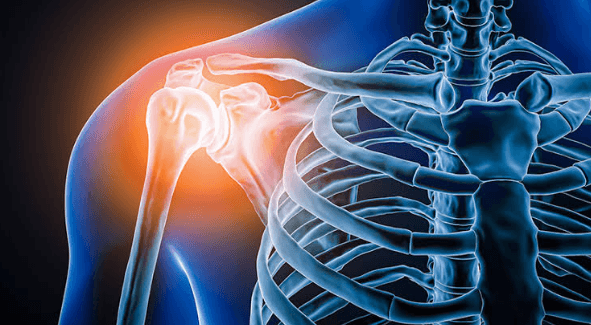
The rotator cuff is a group of four muscles and their tendons that wrap around the shoulder joint, attaching the upper arm bone (humerus) to the shoulder blade (scapula). The four muscles are the supraspinatus, infraspinatus, teres minor, and subscapularis.
Their function is dual: they stabilise the shoulder joint by holding the humeral head tightly against the shallow glenoid socket, and they power the rotational movements of the arm — reaching overhead, rotating the arm inward and outward, and lifting the arm to the side.
Without an intact, functional rotator cuff, the shoulder cannot move smoothly, efficiently, or painlessly. The larger muscles of the shoulder (the deltoid, in particular) cannot compensate fully, leading to weakness, painful arcs of movement, and loss of overhead function.
How Does the Rotator Cuff Tear?
Acute Traumatic Tears
A sudden, forceful event can tear one or more rotator cuff tendons abruptly. Common mechanisms include:
- A fall onto an outstretched hand
- A heavy lifting injury where the arm is suddenly loaded
- A shoulder dislocation (particularly the first dislocation in a middle-aged or older patient, where a rotator cuff tear commonly accompanies the dislocation)
- A direct blow to the shoulder
Acute tears tend to be full-thickness and immediately symptomatic — sudden pain, immediate weakness, inability to lift the arm.
Chronic Degenerative Tears
More commonly, rotator cuff tears in patients over 40 develop gradually through a process of cumulative wear. The tendons lose vascularity with age, becoming more susceptible to microtrauma from repetitive overhead activity. Small tears extend progressively. By the time symptoms become significant, the tendon has often been partially or completely torn for some time.
Many people have rotator cuff tears on MRI without significant symptoms. Studies consistently show that the prevalence of asymptomatic rotator cuff tears increases with age — more than 50% of adults over 70 have some degree of rotator cuff tear on imaging. This is a crucial point: not all tears cause symptoms, and not all tears need treatment.
Grades and Classification of Rotator Cuff Tears
Partial-Thickness Tears
The tendon is partially torn — some fibres are intact, the tear does not extend through the full depth of the tendon. These are subdivided by location:
- Articular-side partial tears (on the joint-facing surface of the tendon) — the most common
- Bursal-side partial tears (on the top surface of the tendon)
- Interstitial partial tears (within the tendon substance, not reaching either surface)
Partial tears are graded by the percentage of tendon thickness involved. Tears of less than 50% are typically managed conservatively initially; tears of more than 50% are more often considered for surgical repair.
Full-Thickness Tears
The tear extends completely through the tendon from the articular to the bursal surface. These are further classified by size:
- Small: Less than 1 cm
- Medium: 1–3 cm
- Large: 3–5 cm
- Massive: More than 5 cm (typically involves two or more tendons)
Size matters because it influences healing potential after repair, the complexity of the surgery, and the risk of re-tear after repair.
Symptoms of a Rotator Cuff Tear
Not every tear is symptomatic, but when they are, the hallmarks include:
- Pain at the outer aspect of the shoulder, often radiating to the upper arm
- A painful arc of movement — pain when lifting the arm between 60 and 120 degrees of elevation
- Weakness with arm elevation and external rotation (turning the arm outward)
- Night pain — lying on the affected shoulder is painful, and many patients are woken by pain
- A catching or grinding sensation with shoulder movement (crepitus)
- Difficulty with overhead activities — reaching for shelves, combing the hair, throwing
For acute tears, these symptoms begin suddenly at the time of injury. For degenerative tears, they typically develop gradually over weeks to months.
Surgery vs. Physiotherapy: What Does the Evidence Show?
This is a nuanced debate, and the honest answer is that neither surgery nor physiotherapy is universally superior. The right choice depends on the tear characteristics and the individual patient.
When Physiotherapy Works Well
Large studies — including the MOON Shoulder Group's work — show that a substantial proportion of patients with symptomatic rotator cuff tears do very well with structured physiotherapy alone. Approximately 74% of patients with atraumatic full-thickness tears who undergo six to twelve weeks of dedicated physiotherapy avoid surgery. The gains from physiotherapy are most reliable when:
- The tear is partial-thickness or small-to-medium full-thickness
- The patient is older (over 60–65) with lower functional demands
- The tear is degenerative rather than acute traumatic
- The surrounding rotator cuff tendons are intact and functioning
In these patients, physiotherapy restores pain-free function at a level that is satisfactory for their lifestyle without the risks and recovery time of surgery.
When Surgery Is the Better Choice
Surgical repair is indicated — or strongly favoured — when:
- The tear is acute traumatic in a young or active patient
- The patient has significant weakness with arm elevation that has not responded to physiotherapy
- The tear is large or massive (greater than 3 cm) in a patient under 65 with high functional demands
- A partial tear involves more than 50% of tendon thickness and has failed three to four months of conservative treatment
- The patient's lifestyle or work demands require reliable overhead arm function
For athletes, manual workers, or patients who need overhead arm use for their occupation, the certainty of repair — when the tear is repairable — is preferable to the uncertainty of whether physiotherapy will maintain adequate function over time.
Arthroscopic Rotator Cuff Repair: How It Works
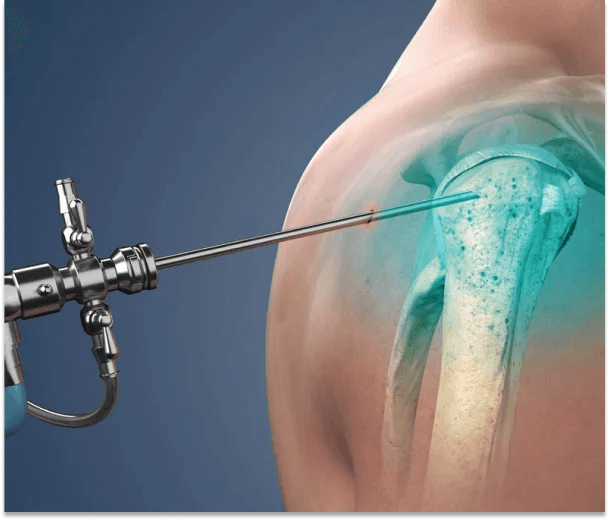
When surgery is indicated, arthroscopic repair is the standard approach. Under anaesthesia, two to four small incisions are made around the shoulder. The arthroscope provides a magnified view of the torn tendon and the adjacent structures. The torn edge of the tendon is prepared and then reattached to the bone of the humeral head using small metal or bioabsorbable anchors threaded with sutures.
The repair is designed to restore the tendon's footprint on the bone. Healing then occurs over several months as the tendon integrates with the bone.
Operative time depends on tear size and complexity: simple, small tears take 45 to 60 minutes; massive tears requiring complex repair or tendon transfer may take two hours or more.
Recovery After Rotator Cuff Repair
Weeks 1–6: Arm in a sling. Passive range-of-motion exercises only. The repair is healing and must be protected from active loading.
Weeks 6–12: Gradual introduction of active-assisted and then active range-of-motion. Sling weaned.
Months 3–6: Strengthening begins. Function improves steadily.
Months 6–12: Full recovery for most daily and recreational activities.
The most important message about recovery: tendon-to-bone healing takes time. Patients who do too much too soon risk disrupting the repair before it has biologically integrated. Patience in the early months is directly related to long-term outcome.
Rotator Cuff Treatment at Dr. Ankur Singh's Practice in Noida
Dr. Ankur Singh manages rotator cuff conditions across the full spectrum — from conservative management with physiotherapy and injection therapy for degenerative partial tears, to complex arthroscopic repair for large and massive tears in active patients. His shoulder arthroscopy practice at KDSG Superspeciality Hospital in Greater Noida serves patients from across Noida, Greater Noida, and the wider Delhi-NCR region.
If you have persistent shoulder pain, weakness with arm elevation, or a known rotator cuff tear and are unsure what the right management is, a specialist evaluation will provide clarity.
To book a consultation for rotator cuff care in Noida or Greater Noida, call the number listed on this website.
Frequently Asked Questions
Can a torn rotator cuff heal on its own without surgery?
A complete full-thickness tear will not heal back to normal without surgery — the tendon ends retract, and the gap fills with scar tissue. However, many patients with full-thickness tears function well long-term with physiotherapy, as the remaining intact cuff muscles compensate. Whether that compensation is adequate depends on tear size, the tendons involved, and the patient's activity demands.
What happens if a rotator cuff tear is not treated?
Small and medium tears may remain stable. Large and massive tears tend to progress over time — the retracted tendon edges undergo fatty infiltration, and the muscle weakens irreversibly. Very large tears that are allowed to progress extensively may eventually become irreparable.
How long does rotator cuff surgery recovery take?
Expect 6 to 12 months for full recovery after surgical repair, depending on the tear size. Sling use continues for 4 to 6 weeks. Most patients return to daily activities by month 3 to 4.
Is rotator cuff surgery available in Greater Noida?
Yes. Dr. Ankur Singh performs arthroscopic rotator cuff repair at KDSG Superspeciality Hospital in Greater Noida.
Dr. Ankur Singh | Best Orthopedic Surgeon in Noida | Rotator Cuff Tear Treatment | Shoulder Arthroscopy Noida | KDSG Superspeciality Hospital, Greater Noida
Medical Disclaimer
The information provided on this website is for educational purposes only and should not be considered as medical advice. Please consult Dr. Ankur Singh or a qualified healthcare professional for personalized medical guidance.
Share this blog:
 Copy
Copy




.jpg)