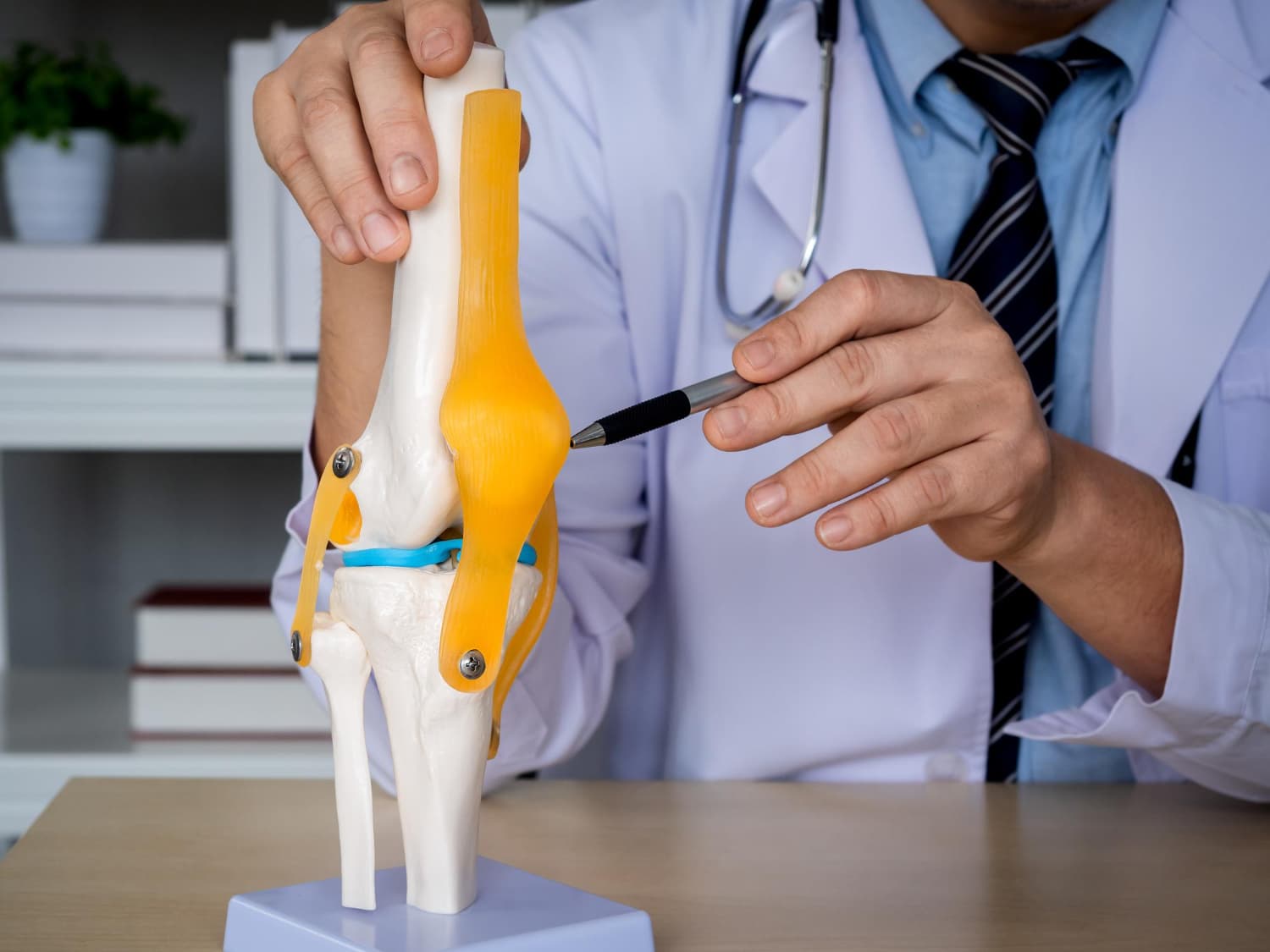
Comparison Guide
Partial vs Total Knee Replacement: Which Is Right for You?
By Dr. Ankur Singh, Director & Head, Orthopaedics & Robotic Joint Replacement, Sarvodaya Hospital, Greater Noida West
Last Reviewed: March 2026 · ~2,500 words
If your knee pain has reached the point where surgery is being discussed, you're probably wondering - do I really need the whole knee replaced, or can we just fix the damaged part?
It's a fair question. Not every arthritic knee needs a total replacement. In the right candidate, a partial replacement preserves more natural bone and ligaments, and the knee genuinely feels more like your own afterward.
As one of the best orthopedic doctors in Noida, I perform both partial and total knee replacements regularly at KDSG Superspeciality Hospitals. What I've learned over 15 years and thousands of cases is that the answer almost always comes down to imaging - where exactly is the damage, and how far has it spread? Patients across Noida, Greater Noida, and the Delhi NCR region come in assuming they need one or the other, and sometimes the X-ray tells a different story.
Here's what you should know about both procedures before your next consultation.
Quick Comparison: Partial Knee Replacement vs Total Knee Replacement
| Feature | Partial Knee Replacement | Total Knee Replacement |
|---|---|---|
| What Is Replaced | One compartment (medial, lateral, or patellofemoral) | All three compartments of the knee |
| Incision Size | 3-4 inches | 8-12 inches |
| Bone Removed | Minimal (75% of knee preserved) | All damaged surfaces replaced |
| Ligaments Preserved | ACL and PCL preserved | ACL typically removed |
| Blood Loss | Significantly less | Standard |
| Hospital Stay | 1-2 days (often same-day) | 2-4 days |
| Walking After Surgery | Same day or next day | 24-48 hours |
| Full Recovery | 4-6 weeks | 3-6 months |
| Range of Motion | More natural (average 130°+) | Good (average 115-120°) |
| Knee Feeling | More natural, "forgotten knee" | Functional but feels artificial |
| Revision Rate (10 years) | Higher (~10-15%) | Lower (~5%) |
| Eligibility | Only 25-30% of patients qualify | Nearly all arthritis patients |
| Cost in India | Rs 2-3.5 lakh | Rs 2.5-4 lakh |
| Best For | Single-compartment arthritis in active patients | Widespread arthritis, significant deformity |
Data compiled from peer-reviewed studies and clinical experience. Individual results may vary.
Important: All costs mentioned in this comparison are approximate estimates for general reference only. These are NOT actual pricing. Actual costs vary significantly based on hospital, implant choice, surgeon, insurance, and individual patient factors. Please contact your nearest orthopedic surgeon for accurate, up-to-date pricing specific to your case.
What Is Partial Knee Replacement?
Partial knee replacement (unicompartmental knee arthroplasty or UKA) replaces only the damaged compartment of the knee while preserving the healthy bone, cartilage, and cruciate ligaments in the rest of the joint.
The knee has three compartments: medial (inner), lateral (outer), and patellofemoral (front). If arthritis is confined to just one compartment and the ligaments are intact, a partial replacement can address the damage while keeping 75% of the natural knee.
How It Works
- 1Pre-operative imaging (X-ray and MRI) to confirm single-compartment disease
- 2Small 3-4 inch incision on one side of the knee
- 3Removal of damaged bone and cartilage from the affected compartment only
- 4Placement of a metal and plastic implant to resurface that compartment
- 5Preservation of all cruciate ligaments and healthy cartilage
- 6Closure — often as outpatient or single-night stay
When Partial Knee Replacement Is Recommended
- Arthritis confined to one compartment (confirmed on X-ray and MRI)
- Intact ACL and PCL ligaments
- Good range of motion (at least 90° flexion)
- Correctable deformity (less than 10-15° varus/valgus)
- BMI under 35 (relative guideline)
- Active patients who want maximum natural knee feeling
What Is Total Knee Replacement?
Total knee replacement (TKA) resurfaces all three compartments of the knee joint. It's the most commonly performed knee replacement worldwide and has been done successfully for over 50 years.
During the procedure, the worn-out surfaces of the femur (thighbone), tibia (shinbone), and patella (kneecap) are removed and replaced with metal and polyethylene implants. The ACL is typically removed as part of the surgery, and the implant design along with the surrounding muscles provides the knee's stability afterward.
How It Works
- 1Pre-operative planning with X-rays and physical examination
- 28-12 inch incision along the front of the knee
- 3Removal of damaged bone and cartilage from all three compartments
- 4Reshaping of femur, tibia, and patella to accept implant components
- 5Placement of metal and polyethylene implants
- 6Balancing of ligaments for proper alignment and stability
- 7Closure and post-operative monitoring
Detailed Comparison: 8 Factors That Matter
1. Who Is a Candidate?
Verdict: Total knee replacement is suitable for more patients. Partial requires strict criteria but offers superior outcomes when those criteria are met.
2. Recovery and Return to Activity
Verdict: Partial wins clearly on recovery speed and natural knee feeling.
3. Implant Longevity and Revision Risk
Verdict: Total has better long-term survival. Partial has higher revision rates but easier revision surgery when needed.
4. Functional Outcomes and Knee Feeling
Verdict: Partial provides a more natural-feeling knee with better range of motion.
5. Cost in India (2026)
Verdict: Partial is less expensive, but the choice should be based on clinical suitability, not cost.
6. Safety and Complications
Verdict: Partial has lower complication rates due to smaller surgery. Both are safe with experienced surgeons.
7. Can These Procedures Be Done Robotically?
Verdict: Both can be done robotically. Robotic assistance is especially beneficial for partial replacement where precision is critical.
8. Age and Activity Level Considerations
Verdict: Younger, active patients with single-compartment disease benefit most from partial. Total is more commonly recommended for older patients or widespread arthritis.
Recovery Timeline Comparison
| Milestone | Partial Knee Replacement | Total Knee Replacement |
|---|---|---|
| Standing/first steps | Same day | 24-48 hours |
| Walking without walker | Week 1-2 | Week 3-4 |
| Return to driving | 2-3 weeks | 6-8 weeks |
| Return to desk work | 1-2 weeks | 6-8 weeks |
| Return to physical work | 4-6 weeks | 3-4 months |
| Low-impact sports | 6-8 weeks | 3-4 months |
| Full recovery | 4-6 weeks | 3-6 months |
Timelines are approximate and vary by individual patient, age, and overall health.
Cost Comparison in India (2026)
| Cost Factor | Partial Knee Replacement | Total Knee Replacement |
|---|---|---|
| Single knee | Rs 2,00,000 - Rs 3,50,000 | Rs 2,50,000 - Rs 4,00,000 |
| Hospital stay | 1-2 days | 2-4 days |
| Physiotherapy sessions | Fewer (4-8 weeks) | More (3-6 months) |
| Time off work | 1-2 weeks (desk), 4-6 weeks (physical) | 6-8 weeks (desk), 3-4 months (physical) |
Prices may vary by hospital and implant choice.
Important: The costs shown above are approximate estimates for general reference only and are NOT actual pricing. Actual surgical costs depend on the hospital, surgeon, type of implant, insurance coverage, and your specific medical condition. Please consult your nearest orthopedic surgeon for an accurate cost estimate tailored to your case.
Which Procedure Is Right for You?
Choose Partial Knee Replacement If:
- Your arthritis is confirmed to one compartment on imaging
- Your ACL and PCL ligaments are intact
- You are active and want the most natural knee feeling
- You want the fastest possible recovery
- You have good range of motion and correctable alignment
- Your BMI is under 35
Choose Total Knee Replacement If:
- Arthritis affects multiple compartments of your knee
- You have significant knee deformity
- Your ACL is torn or degenerated
- You want the longest-lasting single procedure
- You have inflammatory arthritis (rheumatoid, etc.)
- Previous partial replacement has failed
When the Choice Does Not Matter Much:
- When your surgeon recommends a specific procedure based on imaging — trust the clinical assessment
- Both are excellent procedures when performed on the right candidate
Dr. Ankur Singh's Approach
As one of the best orthopedic doctors in Noida, I evaluate every patient at KDSG Superspeciality Hospitals with weight-bearing X-rays, MRI, and a proper clinical examination before recommending partial or total knee replacement.
My philosophy is simple: preserve as much natural knee as possible. When a patient genuinely qualifies for partial replacement, I push for it - the recovery is faster, the knee feels better, and you haven't burned any bridges. If the partial doesn't hold up in 15 years, we can still do a total replacement without much added difficulty.
But I won't recommend a partial when the imaging clearly shows you need a total. I've seen what happens when patients get the wrong procedure - early failure, a more complex revision, and a frustrating outcome. Getting the right procedure for your specific knee is what actually matters.
The Bottom Line
Partial knee replacement recovers faster and feels more natural, but only about 1 in 4 patients actually qualify for it. Total knee replacement works for nearly everyone and lasts longer.
You can't choose between these based on preference alone. Your X-rays and MRI determine which one you're a candidate for. If you're unsure, bring your imaging to KDSG Superspeciality Hospitals in Noida and I'll tell you exactly what your knee needs.
Ready to discuss which option is right for your knee?
Book a consultation with Dr. Ankur Singh at KDSG Superspeciality Hospitals, Noida.
Book ConsultationCall: +91-9711408234
References
- [1]"Unicompartmental Knee Arthroplasty: Long-Term Outcomes and Current Indications." Journal of the American Academy of Orthopaedic Surgeons (2024).
- [2]"Partial vs Total Knee Replacement: A Systematic Review of Patient-Reported Outcomes." The Bone & Joint Journal (2023).
- [3]"The Forgotten Knee: Patient Satisfaction After Unicompartmental Knee Arthroplasty." Clinical Orthopaedics and Related Research (2024).
- [4]"Revision Rates After Unicompartmental vs Total Knee Arthroplasty: National Joint Registry Analysis." BMJ Open (2023).
- [5]"Robotic-Assisted Unicompartmental Knee Arthroplasty: Outcomes and Precision Analysis." Journal of Robotic Surgery (2025).
Medical Disclaimer: This article is for informational purposes only and does not constitute medical advice. Every patient's condition is unique. Please consult with a qualified orthopedic surgeon before making treatment decisions. Results may vary based on individual factors including age, health status, and severity of condition.
Disclosure: Dr. Ankur Singh performs all procedures discussed on this page at KDSG Superspeciality Hospitals, Noida.
Frequently Asked Questions
Have questions about these procedures? Find answers to common concerns below.
Qualification requires arthritis limited to one compartment (confirmed on X-ray and MRI), intact cruciate ligaments, adequate range of motion (at least 90°), and correctable deformity. Dr. Ankur Singh evaluates each patient with comprehensive imaging to determine candidacy.
If a partial replacement fails, it can typically be revised to a total knee replacement. Because partial replacement preserves more bone, the revision surgery is often straightforward with outcomes comparable to a primary total knee replacement.
Yes, this is common when the pattern of arthritis differs between knees. Each knee is evaluated and treated individually based on its specific condition.
Yes. Robotic-assisted partial knee replacement is available and offers excellent precision for implant positioning. The MAKO system is particularly well-known for robotic partial knee replacement.
Not necessarily. Many partial replacements last 15-20+ years without any issues. But there is a chance that arthritis could progress in the other compartments down the line, which would mean converting to a total replacement. It's a possibility I always discuss upfront so patients know what they're signing up for.
Partial knee replacement is typically less painful due to the smaller incision, less bone removal, and preserved soft tissues. Most patients require less pain medication and recover faster.
Medical Disclaimer
The information provided on this website is for educational purposes only and should not be considered as medical advice. Please consult Dr. Ankur Singh or a qualified healthcare professional for personalized medical guidance.