Comparison Guide
Knee Replacement vs Arthroscopy: When Do You Need Which?
By Dr. Ankur Singh, Director & Head, Orthopaedics & Robotic Joint Replacement, Sarvodaya Hospital, Greater Noida West
Last Reviewed: March 2026 · ~2,400 words
"Do I need a knee replacement, or can arthroscopy fix my problem?" I hear this question almost every day at KDSG Superspeciality Hospitals in Noida.
The short answer: it depends on what's wrong with your knee. These two procedures solve completely different problems, and picking the wrong one wastes time and money. Arthroscopy repairs damage inside an otherwise healthy joint. Knee replacement rebuilds a joint that's worn out beyond repair. The confusion happens because both involve knee surgery, but that's about where the similarity ends.
As one of the best orthopedic doctors in Noida, I specialize in both - I did my arthroscopy fellowship at Austria's ESSKA Teaching Center and have been performing joint replacements for over 15 years. That background in both areas helps because I can tell you honestly which one you actually need, rather than just offering the procedure I happen to prefer.
Quick Comparison: Knee Arthroscopy vs Knee Replacement
| Feature | Knee Arthroscopy | Knee Replacement |
|---|---|---|
| What It Does | Repairs internal knee damage | Replaces the entire joint surface |
| Type of Surgery | Minimally invasive (keyhole) | Major joint surgery |
| Incision Size | 2-3 small punctures (5mm each) | 6-12 inches |
| Anesthesia | Regional or general | Spinal or general |
| Surgery Duration | 30-60 minutes | 60-90 minutes |
| Hospital Stay | Day surgery (go home same day) | 2-4 days |
| Walking After Surgery | Same day with crutches | 24-48 hours with walker |
| Full Recovery | 2-6 weeks | 3-6 months |
| Return to Sports | 6 weeks - 6 months (depends on repair) | 4-6 months (low-impact) |
| Treats Arthritis? | No — not a treatment for arthritis | Yes — primary treatment for end-stage arthritis |
| Age Group | Typically 15-55 years | Typically 55-80+ years |
| Cost in India | Rs 80,000 - Rs 1,50,000 | Rs 2,50,000 - Rs 6,00,000 |
| Implants Used | None (repairs natural tissue) | Metal and polyethylene implants |
| Best For | Meniscus tears, ligament injuries, cartilage damage | Severe osteoarthritis, joint degeneration |
Data compiled from peer-reviewed studies and clinical experience. Individual results may vary.
Important: All costs mentioned in this comparison are approximate estimates for general reference only. These are NOT actual pricing. Actual costs vary significantly based on hospital, implant choice, surgeon, insurance, and individual patient factors. Please contact your nearest orthopedic surgeon for accurate, up-to-date pricing specific to your case.
What Is Knee Arthroscopy?
Knee arthroscopy is a minimally invasive surgical procedure where a small camera (arthroscope) and specialized instruments are inserted through 2-3 tiny incisions around the knee. The surgeon can see the inside of the joint on a screen and perform repairs without opening the knee.
Arthroscopy is used to diagnose and treat a wide range of knee problems including meniscus tears, ACL/PCL injuries, cartilage damage, loose bodies, and synovial problems. It preserves the natural joint and aims to restore normal function.
How It Works
- 1Small 5mm incisions (usually 2-3 portals) around the knee
- 2Arthroscope inserted — camera displays joint interior on screen
- 3Diagnostic inspection of all compartments, menisci, and ligaments
- 4Surgical repair: meniscus trimming/repair, loose body removal, cartilage treatment, or ligament reconstruction
- 5Joint irrigation and closure with small adhesive strips
- 6Patient discharged same day in most cases
When Knee Arthroscopy Is Recommended
- Meniscus tears (traumatic, not degenerative)
- ACL or PCL ligament injuries requiring reconstruction
- Loose bodies (cartilage or bone fragments) in the joint
- Cartilage defects or osteochondral lesions
- Synovial diseases (plica syndrome, synovitis)
- Diagnostic evaluation when MRI is inconclusive
- Young, active patients with mechanical knee symptoms
What Is Knee Replacement?
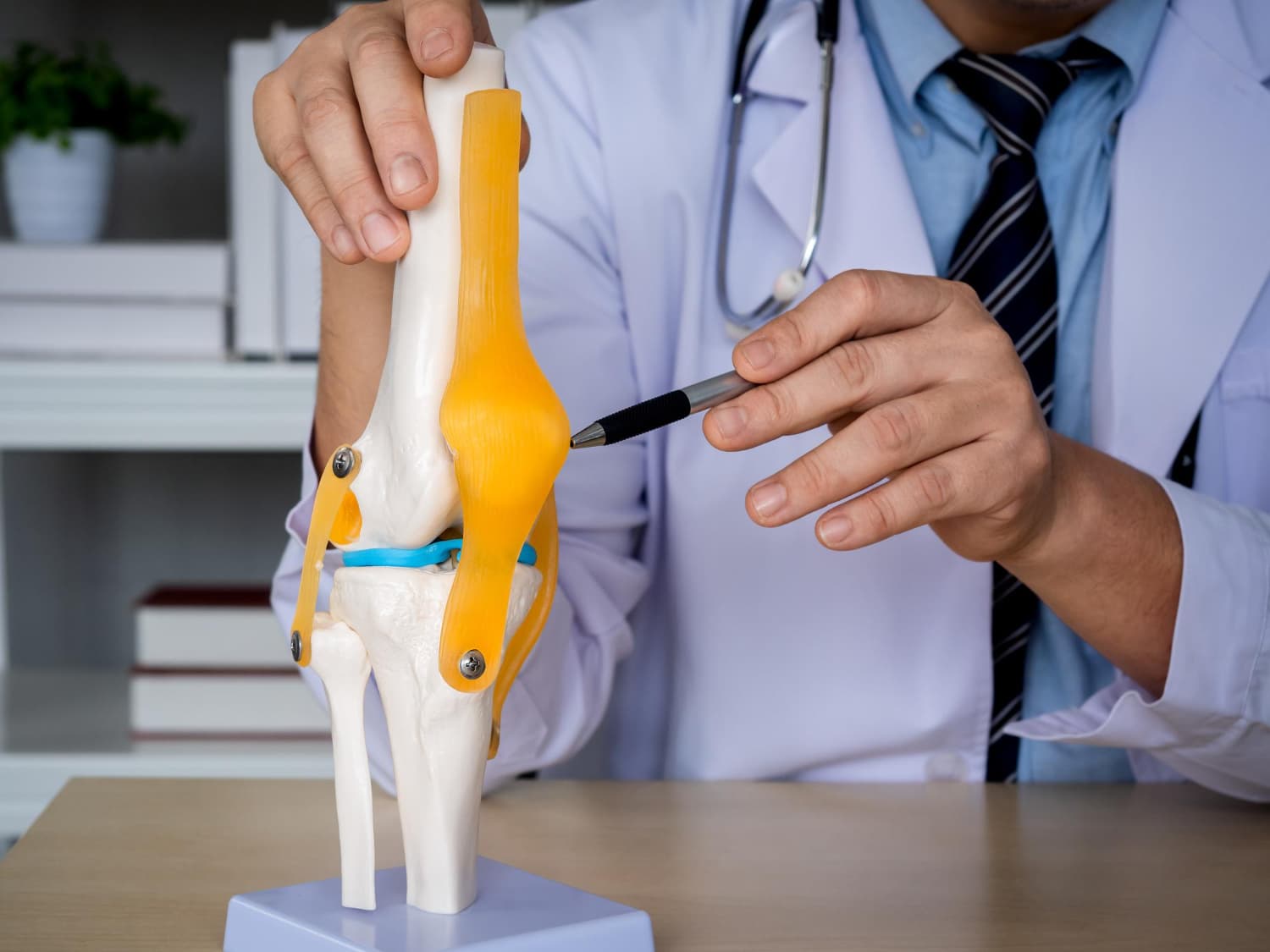
Knee replacement is a major surgical procedure where the damaged surfaces of the knee joint are removed and replaced with artificial implants made of metal alloys and high-grade polyethylene.
It is performed when the knee joint has deteriorated to the point where the cartilage is worn away, bone rubs on bone, and non-surgical treatments no longer provide adequate pain relief. Knee replacement addresses the underlying structural problem of end-stage arthritis.
How It Works
- 1Pre-operative planning with X-rays and clinical examination
- 2Incision of 6-12 inches along the front of the knee
- 3Removal of damaged cartilage and bone surfaces from femur, tibia, and patella
- 4Reshaping of bone to accept implant components
- 5Placement and fixation of metal and polyethylene implants
- 6Ligament balancing for proper alignment
- 7Closure and post-operative rehabilitation program
Detailed Comparison: 7 Factors That Matter
1. Different Conditions, Different Solutions
Verdict: These are not competing procedures — they address fundamentally different conditions.
2. When Arthroscopy Is Not Enough
- Cartilage loss is widespread across multiple compartments
- The knee has significant fixed deformity (bowing or knock-knee)
- Previous arthroscopy for the same degenerative condition provided only temporary relief
- The patient has inflammatory arthritis (rheumatoid) affecting the joint surfaces
Verdict: Arthroscopy for arthritic knees delays proper treatment. If imaging shows advanced degeneration, proceed to replacement evaluation.
3. Age and Activity Considerations
Verdict: The condition determines the procedure, not the age. Both are performed across a wide age range.
4. Recovery Comparison
Verdict: Arthroscopy has much faster recovery. Knee replacement provides more comprehensive long-term relief for arthritis.
5. Cost Comparison in India (2026)
Verdict: Arthroscopy costs significantly less. But the procedures treat different conditions — cost should not drive the decision between them.
6. Common Mistakes Patients Make
Verdict: Get the right diagnosis first with proper imaging. The diagnosis determines the procedure, not the other way around.
7. For Sports Injuries and Active Patients
Verdict: Sports injuries are treated with arthroscopy. Knee replacement is reserved for end-stage joint degeneration.
Recovery Timeline Comparison
| Milestone | Knee Arthroscopy | Knee Replacement |
|---|---|---|
| Go home from hospital | Same day | Day 2-4 |
| Walking without crutches/walker | 1-2 weeks | 3-4 weeks |
| Return to driving | 1-2 weeks | 6-8 weeks |
| Return to desk work | 3-5 days | 6-8 weeks |
| Return to physical work | 2-6 weeks | 3-4 months |
| Return to sports | 6 weeks - 6 months | 4-6 months (low-impact) |
Timelines are approximate and vary by individual patient, age, and overall health.
Cost Comparison in India (2026)
| Cost Factor | Knee Arthroscopy | Knee Replacement |
|---|---|---|
| Procedure cost | Rs 80,000 - Rs 1,50,000 | Rs 2,50,000 - Rs 6,00,000 |
| Hospital stay | Day case (0 nights) | 2-4 nights |
| Physiotherapy | 2-6 weeks | 3-6 months |
| Time off work | 3 days - 6 weeks | 6 weeks - 4 months |
Prices may vary by hospital and implant choice.
Important: The costs shown above are approximate estimates for general reference only and are NOT actual pricing. Actual surgical costs depend on the hospital, surgeon, type of implant, insurance coverage, and your specific medical condition. Please consult your nearest orthopedic surgeon for an accurate cost estimate tailored to your case.
Which Procedure Is Right for You?
Choose Knee Arthroscopy If:
- You have a specific injury (meniscus tear, ligament damage, loose body)
- Your knee joint surfaces are still intact on X-ray
- You have mechanical symptoms (locking, catching, giving way)
- You are young and active with a sports-related injury
- MRI confirms a repairable structural problem
Choose Knee Replacement If:
- X-rays show bone-on-bone arthritis
- You have chronic daily knee pain that limits walking and sleep
- Non-surgical treatments (medications, injections, physiotherapy) have failed
- Your knee has significant deformity
- You have difficulty with basic daily activities
When the Choice Does Not Matter Much:
- These procedures are not interchangeable — the right procedure is determined by diagnosis
- If your diagnosis is unclear, proper imaging (X-ray + MRI) will clarify which procedure is appropriate
Dr. Ankur Singh's Approach
I always start with proper imaging - weight-bearing X-rays and MRI when needed. The images tell me what's actually happening inside your knee, and that determines the treatment. As one of the best orthopedic doctors in Noida with fellowship training in arthroscopy from Austria's ESSKA Teaching Center, I'm equally comfortable with both arthroscopic and replacement procedures.
If you have a specific injury and your joint surfaces are still healthy, arthroscopy is the obvious answer. If your X-rays show advanced arthritis, I'll recommend knee replacement and explain honestly why arthroscopy won't help in your case.
I perform both procedures regularly at KDSG Superspeciality Hospitals in Noida. The advantage of seeing a surgeon who does both is that my recommendation is based on your diagnosis, not on which procedure I happen to specialize in.
The Bottom Line
These two procedures solve different problems. Don't ask "which is better" - ask "what's wrong with my knee?" A torn meniscus in a healthy joint needs arthroscopy. A worn-out arthritic joint needs replacement. The imaging makes this clear in most cases.
If you're confused about which procedure you need, a consultation with proper imaging will give you a straight answer. Book a visit at KDSG Superspeciality Hospitals in Noida - as one of the best orthopedic surgeons in Noida, I'll review your X-rays and MRI and tell you exactly where things stand.
Ready to discuss which option is right for your knee?
Book a consultation with Dr. Ankur Singh at KDSG Superspeciality Hospitals, Noida.
Book ConsultationCall: +91-9711408234
References
- [1]"Arthroscopic Surgery for Degenerative Knee: Systematic Review and Meta-Analysis of Benefits and Harms." BMJ (2017).
- [2]"Knee Arthroscopy versus Conservative Management in Patients with Degenerative Knee Disease." NEJM (2013).
- [3]"Indications for Knee Arthroscopy in 2026: Evidence-Based Guidelines." Arthroscopy: The Journal of Arthroscopic & Related Surgery (2025).
- [4]"Total Knee Arthroplasty vs Arthroscopic Debridement for Osteoarthritis." Journal of Bone and Joint Surgery (2024).
- [5]"Return to Sport After Knee Arthroscopy: Systematic Review." Sports Medicine (2023).
Medical Disclaimer: This article is for informational purposes only and does not constitute medical advice. Every patient's condition is unique. Please consult with a qualified orthopedic surgeon before making treatment decisions. Results may vary based on individual factors including age, health status, and severity of condition.
Disclosure: Dr. Ankur Singh performs all procedures discussed on this page at KDSG Superspeciality Hospitals, Noida.
Frequently Asked Questions
Have questions about these procedures? Find answers to common concerns below.
In some cases, yes. Treating a meniscus tear or cartilage defect early can prevent progressive joint damage. However, arthroscopy cannot reverse existing arthritis or stop its progression.
If your pain returned after arthroscopy, it may indicate underlying arthritis that arthroscopy cannot address. Updated X-rays will show whether the joint has degenerated to the point where replacement is needed.
Not at the same time. Some patients have arthroscopy first and later progress to knee replacement as arthritis develops. Arthroscopy done years before does not complicate future knee replacement.
Yes, arthroscopy is safe at any age if the indication is appropriate (such as a locked knee from a loose body). However, arthroscopy for degenerative meniscus tears in elderly patients with arthritis is generally not recommended.
Weight-bearing X-rays show arthritis (joint space narrowing, bone spurs). MRI shows soft tissue problems (meniscus tears, ligament injuries). Both tests together give a complete picture. Dr. Ankur Singh can evaluate your specific case.
Injections (corticosteroid, hyaluronic acid, PRP) can provide temporary relief and delay surgery. They work best for mild-to-moderate arthritis but do not replace surgery when the joint has significantly degenerated.
Medical Disclaimer
The information provided on this website is for educational purposes only and should not be considered as medical advice. Please consult Dr. Ankur Singh or a qualified healthcare professional for personalized medical guidance.